Contentsexpand_more
- What is an E-Max Veneer?
- What is the Difference Between E-Max Veneer and Zirconium?
- What is a Laminate E-Max Veneer and How is It Placed?
- Care Guidelines Derived from E-Max Veneer Reviews
- Understanding E-Max Veneer Cost Factors
- Comparison Matrix: E-Max vs. Zirconia Restorations
- Frequently Asked Questions (FAQ)
- Can an E-Max veneer detach or fracture easily?
- Do E-Max veneers stain or discolor over time?
- Can E-Max be utilized on posterior molar teeth?
In contemporary smile design, the primary objective extends beyond creating uniform white teeth; it requires replicating the precise optical translucency, micro-depth, and fluorescence inherent to natural dental enamel. The artificial, opaque appearance historically associated with metal-fused restorations has been superseded by all-ceramic systems. Within biomimetic cosmetic dentistry, the gold standard restoration is the E-Max veneer.
Engineered for anterior smile line transformations, this technology is the preferred choice for patients seeking natural aesthetics, correcting intrinsic discolorations, or aligning minor crowding. Patients evaluating treatment frequently ask: "Is an E-Max veneer durable?", "How does it differ from zirconium?", "Can it fracture?", and "How is a laminate E-Max fitted?" In this comprehensive manual compiled at Livera Dental Clinic, we evaluate what is an E-Max veneer, analyze the difference between E-Max veneer and zirconium, explore laminate E-Max veneer protocols, provide maintenance insights from E-Max veneer reviews, and review factors governing E-Max veneer cost.
What is an E-Max Veneer?
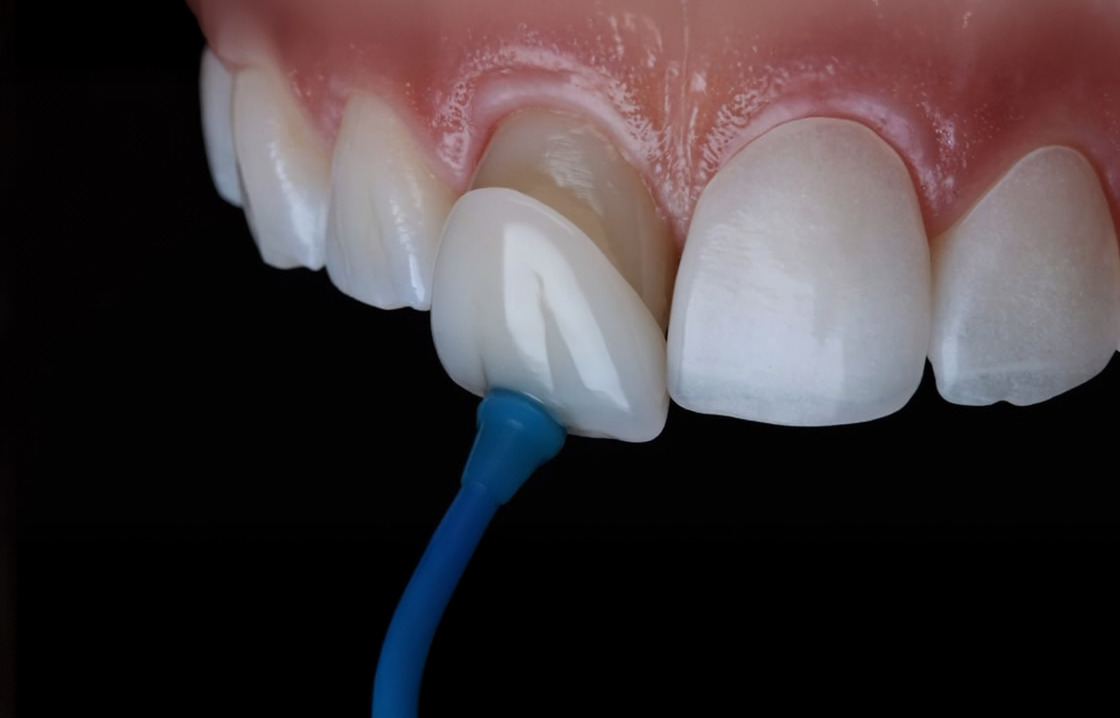
For patients seeking clinical clarity on what is an E-Max veneer, the medical definition is: E-Max (Empress Max) is a monolithic, all-ceramic dental restoration pressed or milled from high-density lithium disilicate glass-ceramic, containing zero metal framework or opaque internal substructures.
Its glass-ceramic crystalline matrix exhibits a refractive index matching that of natural enamel. Rather than reflecting light opaquely, it allows light transmission (translucency), ensuring the restoration maintains depth under natural sunlight, photography flashes, and ambient lighting.
What is the Difference Between E-Max Veneer and Zirconium?
A primary dilemma encountered by patients during cosmetic consultations is the difference between E-Max veneer and zirconium. While both materials are biocompatible and metal-free, their structural and optical profiles dictate distinct clinical applications:
Translucency and Natural Aesthetics: E-Max possesses superior optical translucency due to its lithium disilicate crystal network. For anterior smile design, E-Max provides the most natural aesthetic outcome. Zirconia features a denser polycrystalline structure; while exceptional at masking severely discolored underlying tooth structure, it lacks the optical depth of E-Max.
Mechanical Strength (Flexural Strength): Zirconium crowns exhibit flexural strengths between 1000 and 1200 MPa, providing extreme fracture resistance. E-Max restorations deliver flexural strengths between 400 and 500 MPa. This strength is optimal for anterior teeth and premolars; however, for posterior multi-unit bridges under heavy masticatory loads, zirconia is preferred.
Tooth Structure Preservation: Placing a laminate E-Max veneer requires minimal preparation, removing only 0.3 to 0.7 mm from the facial enamel surface (or utilizing no-prep approaches). Conventional full-coverage zirconia crowns require circumferential preparation of the tooth.
Adhesive Bonding Mechanism: E-Max glass-ceramics are etched with hydrofluoric acid and silanated, forming a micromechanical and chemical bond with composite resin cements. Zirconia cannot be acid-etched in the same manner, relying more on mechanical retention and specialized primers.
What is a Laminate E-Max Veneer and How is It Placed?
Known as porcelain laminate veneers, a laminate E-Max veneer consists of ultra-thin, custom-crafted ceramic shells bonded to the facial surface of teeth. The clinical workflow includes:
Digital Smile Design (DSD) & Mock-Up: High-resolution intraoral 3D scans and facial photographs generate a digital aesthetic blueprint. A temporary intraoral mock-up allows the patient to preview their smile before enamel preparation.
Conservative Enamel Preparation: Minimal preparation (0.3 to 0.7 mm) is performed within the enamel layer.
Precision CAD/CAM Milling: Digital models are transferred to 5-axis CAD/CAM milling units to fabricate individualized E-Max veneers, followed by ceramic crystallization and characterization.
Adhesive Cementation: Veneers are conditioned and bonded to enamel using light-cured resin cements.
Care Guidelines Derived from E-Max Veneer Reviews
Insights compiled from clinical follow-ups and E-Max veneer reviews highlight key longevity rules:
Brush twice daily with a non-abrasive fluoride toothpaste and maintain daily interdental flossing.
E-Max restorations possess hardness equivalent to natural enamel; avoid biting non-food items, opening packaging with teeth, or chewing on hard ice.
Patients with sleep bruxism (nocturnal grinding) must wear a custom night guard to shield the ceramic interfaces from excessive eccentric loads.
Understanding E-Max Veneer Cost Factors
Evaluating E-Max veneer cost parameters involves case-specific variables. Primary cost determinants in 2026 include:
Number of Restorative Units: Comprehensive smile design involving 6 to 10 anterior maxillary veneers shapes the overall clinical scope.
Ceramist Artistry and Digital CAD/CAM Protocols: Custom shade grading, individual translucency mapping, and laboratory firing require specialized technical expertise.
Adjunctive Aesthetic Treatments: Pre-restorative procedures, such as laser gingivoplasty (pink aesthetics) or minor alignment, influence the total treatment plan.
Comparison Matrix: E-Max vs. Zirconia Restorations
Feature | E-Max (Lithium Disilicate) | Zirconium (Zirconium Oxide) |
Optical Translucency | Superior (Closest match to natural enamel) | Good / Semi-Opaque |
Flexural Strength | 400-500 MPa | 1000-1200 MPa (Extremely High) |
Primary Indication | Anterior Incisors, Canines & Laminates | Posterior Molars & Long-Span Bridges |
Preparation Depth | Minimal (0.3-0.7 mm Laminate) | Standard (1.0-1.5 mm Full Crown) |
Adhesive Bonding Strength | Exceptional (Etchable Glass-Ceramic) | High (Requires dedicated primers) |
Masking Dark Substructures | Low to Moderate (Transmits underlying shade) | Superior (Blocks dark backgrounds completely) |
Frequently Asked Questions (FAQ)
Can an E-Max veneer detach or fracture easily?
E-Max veneers are bonded to enamel using adhesive resin protocols. This chemical and micromechanical bond integrates the veneer with the tooth structure, making spontaneous detachment rare. In terms of strength, E-Max withstands normal physiological biting forces in the anterior zone. However, traumatic impacts or using teeth as tools can chip porcelain, just as it would fracture natural enamel.
Do E-Max veneers stain or discolor over time?
No, E-Max is a dense, non-porous glazed glass-ceramic. Because its surface lacks microscopic pores, it is resistant to external staining from coffee, tea, red wine, or tobacco. The restorations maintain their original shade, surface gloss, and optical translucency over decades of wear.
Can E-Max be utilized on posterior molar teeth?
Yes, E-Max can be used on single posterior molars as full crowns or partial onlays/inlays where occlusal forces are balanced. However, in multi-unit posterior bridges replacing missing molars, E-Max is contraindicated due to shear stress limitations, and high-strength monolithic zirconia is preferred.