Contentsexpand_more
- What is Teeth Whitening and How Does It Work?
- Is Laser Teeth Whitening Harmful?
- Is Baking Soda Teeth Whitening Harmful?
- Is At Home Teeth Whitening Harmful?
- Is In Office Teeth Whitening Harmful?
- Why Does Teeth Whitening Sensitivity Occur and Is It Normal?
- Contraindications: When Should Teeth Whitening Be Avoided?
- Factors Influencing Teeth Whitening Cost
- Comparison Matrix: In-Office Bleaching vs. Take-Home Trays vs. Baking Soda
- Frequently Asked Questions (FAQ)
- Does professional teeth whitening thin, weaken, or dissolve dental enamel?
- How long do teeth whitening results last, and will teeth revert immediately?
- Are commercial over-the-counter whitening toothpastes safe for daily use?
Looking in the mirror, you may observe that coffee, tea, or natural aging have darkened your dental enamel by several shades, prompting a desire for a brighter smile. Yet before scheduling an aesthetic dental visit or ordering over-the-counter kits, a critical question arises: "Is teeth whitening harmful?", "Does teeth whitening damage enamel?", and "Will my teeth become permanently sensitive to cold water?" Conflicting online claims, unregulated chemical formulations, and DIY baking soda trends provoke understandable patient anxiety. In clinical esthetic dentistry, professional teeth whitening (dental bleaching), when executed following comprehensive case selection, calibrated active agent concentrations, and direct clinical supervision, ranks among the safest and most conservative treatments in oral care.
Dental enamel is the hardest, most mineralized tissue in the human body. Professional bleaching agents (hydrogen peroxide or carbamide peroxide) do not dissolve, etch, or abrade enamel thickness; they diffuse through microscopic enamel porosities to cleave the chemical double-bonds of trapped organic chromogens through active oxidation. Biological risk does not stem from supervised clinical protocols, but from unmonitored acidic DIY pastes and coarse abrasives.
What is Teeth Whitening and How Does It Work?
In restorative dentistry, the clinical definition of what is teeth whitening is: A chemical oxidation process wherein controlled concentrations of hydrogen peroxide or carbamide peroxide penetrate the semi-permeable hard tissue layers of enamel and dentin to degrade trapped organic chromophore molecules without compromising the inorganic hydroxyapatite crystalline matrix.
The biochemical mechanism proceeds as follows:
Upon application to clean enamel prisms, unstable peroxide molecules dissociate into reactive oxygen free radicals.
These electrophilic oxygen radicals target complex, conjugated double-bond organic color rings deposited from tea, coffee, wine, or tobacco.
Cleaving these complex pigments into smaller, unpigmented molecules alters internal light reflectance, restoring the natural, bright optical appearance of the tooth.
Is Laser Teeth Whitening Harmful?
Examining common patient concerns regarding is laser teeth whitening harmful:
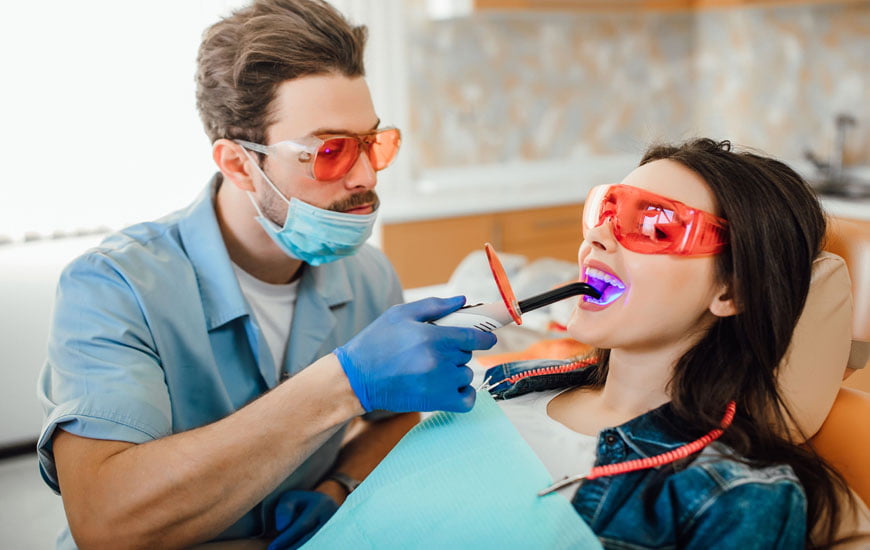
No Radiation or Thermal Burn Risks: Specialized dental lasers and cold-spectrum LED light units do not bleach enamel independently; they act as photo-thermal or photo-chemical catalysts that accelerate the breakdown of the applied peroxide formulation.
The Critical Importance of Temperature Control: Low-end, uncalibrated bleaching lamps generate excess heat, risking thermal hyperemia or irreversible pulpitis within the pulp chamber. Conversely, calibrated medical-grade laser systems maintain thermal changes well below safe physiological thresholds.
Supervised Speed and Safety: Because laser irradiation accelerates gel activation, chairside exposure times are reduced to 45 minutes, minimizing prolonged chemical contact with tooth surfaces and optimizing safety.
Is Baking Soda Teeth Whitening Harmful?
Regarding household DIY protocols and is baking soda teeth whitening harmful, clinical consensus is clear:
Mechanical Wear vs. Chemical Whitening: Sodium bicarbonate (baking soda) crystals possess sharp, irregular microscopic edges. Brushing directly with baking soda functions like sandpaper against enamel.
Micro-Scratches and Enamel Thinning: While baking soda scours superficial external pellicle stains initially, it produces microscopic grooves across the enamel surface.
Accelerated Re-Staining: Roughened, scratched enamel prism surfaces act as physical traps for dietary chromogens, causing teeth to stain faster and deeper over time.
Dentin Exposure and Hypersensitivity: Chronic abrasive scrub regimens erode the protective enamel layer, exposing underlying yellow dentin and inducing chronic thermal hypersensitivity.
Is At Home Teeth Whitening Harmful?
Distinguishing between professionally fabricated home systems and unregulated commercial products:
Dentist-Supervised Take-Home Trays Are Safe: Clinicians capture precise 3D digital impressions to fabricate custom-scalloped reservoir trays that hold mild carbamide peroxide gels (10% to 16%). These custom margins prevent gel from contacting delicate gingival borders, ensuring safe shade progression.
Over-the-Counter Kits and Whitening Pens Pose Risks: Universal, non-custom boil-and-bite trays fit poorly, allowing bleaching agents to leak across the gingiva, causing chemical ulcerations and recession. Furthermore, unregulated products often feature low pH levels that demineralize enamel.
Is In Office Teeth Whitening Harmful?
Evaluating clinical safety parameters governing in-office teeth whitening:
Complete Gingival Isolation: Prior to gel placement, an elastic light-cured resin dam (gingival barrier) is placed along the gingival margins. This isolation prevents concentrated clinical peroxide from contacting soft oral tissues.
Controlled Exposure Windows: The bleaching gel is applied in discrete 15-minute cycles, allowing continuous clinical monitoring of tooth hydration and patient comfort.
Enamel Integrity is Preserved: Rigorous international laboratory and clinical evaluations confirm that dental associations (such as the ADA and FDI) endorse professional bleaching gels as non-destructive to enamel mineral density.
Why Does Teeth Whitening Sensitivity Occur and Is It Normal?
Understanding the biological mechanisms behind post-whitening tooth sensitivity:
Transient Sensitivity is Biologically Normal: Peroxide diffusion temporarily clears mineral plugs within microscopic enamel porosities, increasing fluid movement through dentinal tubules toward pulp nociceptors. This can manifest as mild, transient "zingers" when exposed to chilled fluids during the first 24 to 48 hours.
Zero Permanent Neural Damage: Within two days, natural salivary electrolytes (calcium and phosphate) remineralize exposed micro-pores, eliminating sensitivity spontaneously.
Clinical Desensitization Protocols: At Livera Dental Clinic, applying potassium nitrate and sodium fluoride varnishes before and after bleaching minimizes transient sensitivity.
Contraindications: When Should Teeth Whitening Be Avoided?
Clinical situations where dental bleaching is inadvisable or must be deferred:
Pregnancy and Lactation: Clinical safety trials are ethically restricted in pregnant and lactating patients; elective bleaching should be postponed post-nursing.
Patients Under 18 Years of Age: Immature teeth feature large pulp chambers and incompletely calcified enamel, increasing pulpal sensitivity risks.
Severe Gingival Recession and Exposed Roots: Root cementum is thin and lacks enamel protection; bleaching agents contacting exposed root dentin trigger severe pain. Periodontal management must precede whitening.
Untreated Carious Lesions and Structural Cracks: Active decay allows bleaching gel to penetrate directly into the pulp, inducing acute chemical pulpitis. Complete restorative care is required first.
Existing Front Crowns and Extensive Resin Restorations: Peroxide does not bleach restorative materials (porcelain or composite resins). Bleaching natural teeth adjacent to old restorations creates visible shade mismatches.
Factors Influencing Teeth Whitening Cost
Health regulations restrict advertising static treatment fees; clinical costs depend on case complexity. Primary variables include:
Selected Bleaching Modality: In-office chairside laser bleaching, custom dentist-supervised take-home systems, or combination regimens.
Bio-Material Class and Technology: Certified neutral-pH bleaching gels (e.g., Philips Zoom, Opalescence) and clinical cold-LED or diode laser activation systems.
Pre-Bleaching Prophylaxis Requirements: Professional ultrasonic scaling, airflow polishing, and stain debridement required to prepare clean enamel surfaces.
Case Complexity and Remineralization Kits: Managing deep intrinsic tetracycline bands or fluorosis cases requiring extended treatment cycles and biomimetic remineralization pastes.
Comparison Matrix: In-Office Bleaching vs. Take-Home Trays vs. Baking Soda
Clinical Parameter | Professional In-Office Whitening | Dentist-Supervised Take-Home | DIY Baking Soda Scrub |
Supervising Provider | Licensed Dental Clinician | Patient (Clinical guidance) | Self-administered (Unregulated) |
Enamel Structural Impact | Preserves enamel integrity | Preserves enamel integrity | Micro-scratches and abrades enamel |
Active Chemical Agent | 35% – 40% Hydrogen Peroxide | 10% – 16% Carbamide Peroxide | Sodium Bicarbonate abrasive salt |
Treatment Timeline | 45 – 60 Minutes (Single visit) | 7 – 14 Days (4-6 hours daily) | Fleeting superficial scrub effect |
Gingival Protection | 100% Protected via resin dam | Custom-scalloped tray edges | Causes mechanical gum chafing |
Shade Improvement | 4 to 8 Shades lighter | 2 to 4 Shades lighter | 0 – 1 Shade (Surface plaque only) |
Clinical Safety Profile | Maximum Medical Safety | High Clinical Safety | Harmful and Destructive |
Frequently Asked Questions (FAQ)
Does professional teeth whitening thin, weaken, or dissolve dental enamel?
No. High-grade clinical bleaching gels operate at a neutral pH and do not dissolve inorganic tooth minerals or thin the enamel shell. The reaction targets and breaks down trapped organic pigment macromolecules within microscopic enamel spaces through safe oxidation. Your enamel thickness remains identical before and after professional treatment.
How long do teeth whitening results last, and will teeth revert immediately?
Whitening results typically endure for 1.5 to 3 years, depending on dietary habits and oral hygiene. For the first 48 hours following treatment, adhering to a "white diet" (avoiding coffee, tea, red wine, dark sauces, and tobacco) is essential while enamel pores remineralize. Following this initial window, routine oral care and scheduled hygiene visits prevent rapid shade regression.
Are commercial over-the-counter whitening toothpastes safe for daily use?
Many commercial whitening toothpastes do not alter internal tooth shade; instead, they contain high Relative Dentin Abrasivity (RDA) particles designed to scrub away external pellicle stains mechanically. Daily, aggressive scrubbing with highly abrasive pastes can wear down cervical enamel margins and trigger chronic sensitivity over time. Whitening toothpastes should be limited to 1 to 2 uses per week alongside a fluoride paste.