Contentsexpand_more
- What Is Sinus Lift Surgery?
- Closed Sinus Lift vs. Open Sinus Lift Surgery
- 1. Closed Sinus Lift Surgery (Osteotome / Indirect Technique)
- 2. Open Sinus Lift Surgery (Lateral Window / Direct Technique)
- How Long Does Sinus Lift Surgery Take?
- How Long Does Sinus Lift Surgery Take to Heal?
- Swelling After Sinus Lift Surgery and Inflammatory Management
- Essential Post-Op Guidelines After Sinus Lift Surgery
- Comparison Matrix: Closed vs. Open Sinus Lift Techniques
- Frequently Asked Questions (FAQ)
- What happens if the sinus membrane tears during surgery?
- Is minor nosebleeding normal after sinus lift surgery?
- Are bone graft materials used in sinus lift surgery safe?
When teeth are lost in the posterior maxilla (upper molar and premolar regions), the surrounding alveolar bone undergoes progressive vertical and horizontal resorption. Concurrently, the pneumatic air cavities located directly above the upper jawbone (the maxillary sinuses) expand downward due to gravity and lack of functional occlusal loading, a process known as sinus pneumatization. This anatomical shift reduces the vertical bone height required to securely anchor dental implants. To prevent implants from penetrating the sinus cavity and to build a solid structural foundation, a surgical procedure known as sinus lift surgery (sinus augmentation) is performed.
Because it involves a surgical intervention, patients often have concerns regarding post-operative discomfort, facial swelling, and healing timelines. However, modern piezo-electric bone surgery, microsurgical instrumentation, and advanced biocompatible bone grafts have transformed sinus augmentation into a highly predictable, comfortable, and routine procedure. In this evidence-based manual compiled by the maxillofacial surgeons at Livera Dental Clinic, we evaluate open sinus lift surgery, closed sinus lift surgery, operational durations, managing swelling after sinus lift surgery, and essential after sinus lift surgery care protocols.
What Is Sinus Lift Surgery?
For patients seeking clarity during diagnostic consultations, the medical definition of sinus lift surgery involves delicately elevating the Schneiderian membrane (the thin membrane lining the maxillary sinus floor) using specialized hand instruments, followed by placing synthetic, xenograft, or allograft bone materials into the newly created space beneath the membrane.
This bone augmentation protocol safely establishes the vertical bone dimension (a minimum of 8 to 10 mm) required for primary stability and long-term osseointegration of dental implants.
Closed Sinus Lift vs. Open Sinus Lift Surgery
Sinus augmentation is categorized into two surgical modalities based on the patient's baseline vertical bone height:
1. Closed Sinus Lift Surgery (Osteotome / Indirect Technique)
Clinical Indications: Selected when the existing residual bone height in the posterior maxilla measures between 5 and 8 mm.
Surgical Approach: No lateral window is created through the outer sinus wall. Instead, access is achieved directly through the prepared implant site. Specialized osteotomes gently tap and elevate the sinus floor by 2 to 3 mm.
Clinical Advantages: Minimally invasive with minimal or no suturing required. Implants are typically placed during the same surgical appointment. Post-operative recovery is rapid, with minimal swelling or discomfort.
2. Open Sinus Lift Surgery (Lateral Window / Direct Technique)
Clinical Indications: Indicated when severe bone resorption leaves a residual vertical bone height of less than 5 mm.
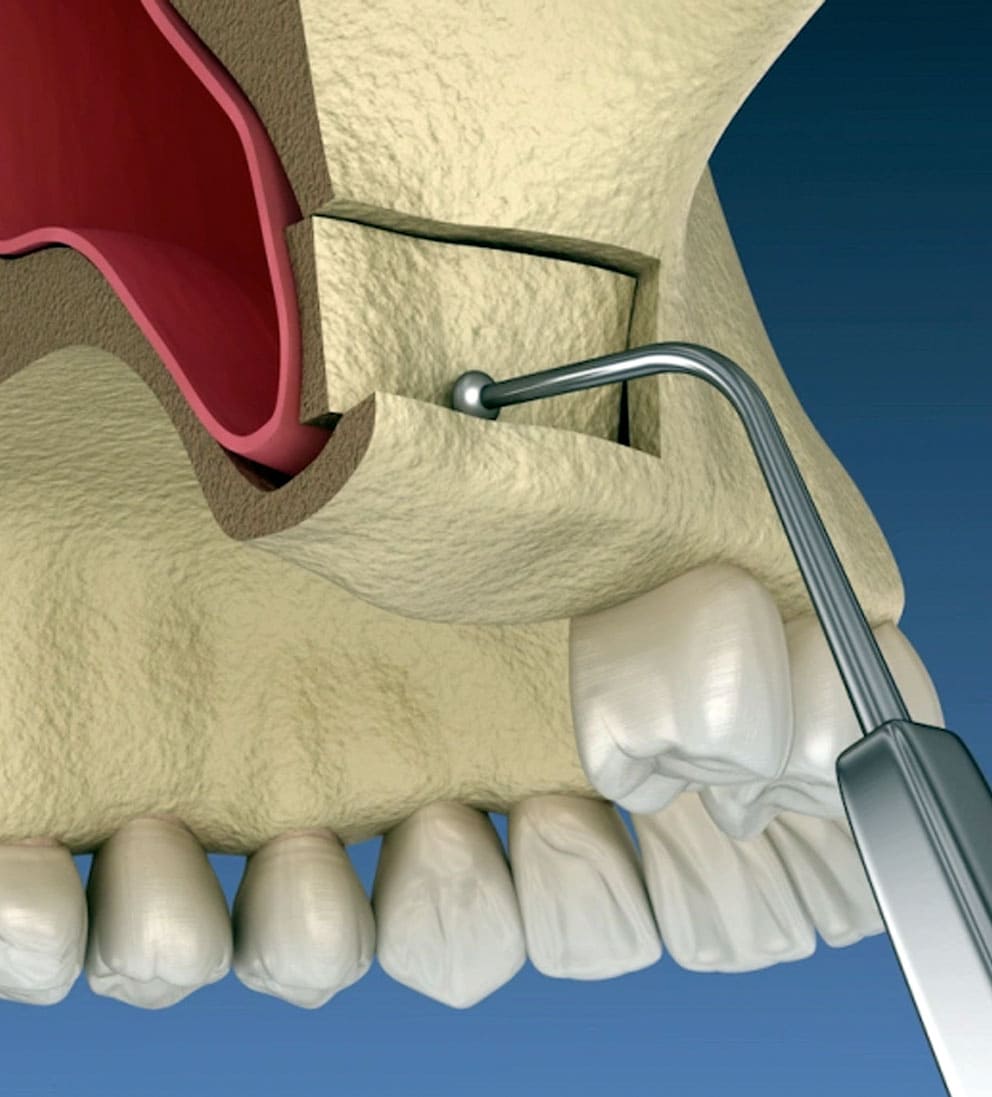
Surgical Approach: A small surgical window (lateral window) is created on the outer facial wall of the maxillary sinus. Under direct visualization, the Schneiderian membrane is carefully reflected upward, and a substantial volume of bone graft material is packed into the space.
Clinical Advantages: Allows for significant vertical bone gains. If the baseline bone is insufficient to achieve primary implant stability, the graft is allowed to consolidate for 4 to 6 months before implants are placed in a second stage.
How Long Does Sinus Lift Surgery Take?
When evaluating how long does sinus lift surgery take, the duration depends on the surgical approach and the number of sites being treated:
Closed Sinus Lift: Typically requires 15 to 30 minutes for a single implant site.
Open Sinus Lift: Requires 45 to 60 minutes per side due to lateral window preparation, careful membrane elevation, and extensive grafting.
Performed under local anesthesia or intravenous sedation, the patient experiences no pain or sharp discomfort during the procedure.
How Long Does Sinus Lift Surgery Take to Heal?
Answering how long does sinus lift surgery take to heal involves evaluating two distinct biological phases:
Soft Tissue Healing (Initial Phase): Closure of mucosal incisions and stabilization of surgical sutures takes approximately 7 to 10 days, after which sutures are removed or dissolve. Patients generally return to light daily activities within 2 to 3 days.
Hard Tissue Osseointegration (Bone Consolidation): The maturation and integration of the bone graft with the surrounding natural bone matrix requires 4 to 6 months before it can handle functional loading.
Swelling After Sinus Lift Surgery and Inflammatory Management
Post-operative edema, or swelling after sinus lift surgery, is a normal physiological response to surgical manipulation, particularly following lateral window procedures.
Peak Swelling Timeline: Swelling typically peaks between 48 and 72 hours post-surgery. It begins to subside on day 4 and generally resolves within 7 days.
Clinical Swelling Management:
Apply external cold compresses (ice packs) to the cheek for 10-minute intervals during the first 24 hours.
Sleep with your head elevated on two pillows for the first two nights to promote lymphatic drainage.
Take prescribed anti-inflammatory and analgesic medications as directed by your surgeon.
Essential Post-Op Guidelines After Sinus Lift Surgery
Long-term success depends heavily on adherence to instructions after sinus lift surgery. Because the elevated sinus membrane is sensitive to intraoral and nasal pressure changes, specific precautions must be observed:
Avoid Forceful Nose Blowing: Do not blow your nose forcefully. Pressure changes can displace the bone graft or tear the delicate membrane. Gently dab the nose if necessary.
Sneeze with Your Mouth Open: If you need to sneeze, keep your mouth open to allow air pressure to vent through the oral cavity rather than the nasal passages.
Do Not Use Straws or Create Oral Suction: Avoid drinking through straws or creating negative intraoral pressure, which can disrupt the surgical site and trigger bleeding.
Strict Smoking Cessation: Tobacco smoke compromises mucosal healing and increases the risk of graft infection. Refrain from smoking for at least 2 weeks post-surgery.
Avoid Air Travel and Scuba Diving: Avoid air travel and deep-sea diving for 10 to 14 days post-surgery to prevent rapid atmospheric pressure shifts from stressing the sinus cavity.
Comparison Matrix: Closed vs. Open Sinus Lift Techniques
Clinical Parameter | Closed Sinus Lift (Indirect) | Open Sinus Lift (Direct) |
Baseline Bone Height | 5 to 8 mm residual bone height | Less than 5 mm residual bone height |
Surgical Access | Direct access through the implant preparation site | Lateral window created on the outer sinus wall |
Volume of Bone Graft | Minimal volume (2 to 3 mm elevation) | Substantial volume for large vertical gains |
Implant Placement Timing | Simultaneous with sinus elevation | Simultaneous or delayed (4–6 months post-healing) |
Procedure Duration | 15 to 30 minutes | 45 to 60 minutes |
Post-Op Swelling | Minimal to none | Moderate (peaks at 48–72 hours) |
Frequently Asked Questions (FAQ)
What happens if the sinus membrane tears during surgery?
Because the Schneiderian membrane is delicate, small micro-perforations can occasionally occur during elevation. An experienced surgeon will recognize the tear immediately and repair it using absorbable collagen membranes (biological patches) or specialized micro-suturing techniques. If a large tear occurs, the grafting procedure may be paused to allow the membrane to heal for 2 to 3 months before safely re-attempting the elevation.
Is minor nosebleeding normal after sinus lift surgery?
Yes, experiencing light, pinkish nasal discharge or minor bleeding from the nostril on the operated side during the first 24 to 48 hours is considered normal. This occurs as small capillary oozing from the surgical site drains through the sinus ostium into the nasal cavity. However, if active, dark red, or persistent bleeding occurs, contact your surgeon immediately.
Are bone graft materials used in sinus lift surgery safe?
Yes, bone graft materials used in modern oral surgery are approved by international health authorities (such as the FDA and CE) and undergo rigorous processing and sterilization. Whether synthetic, bovine-derived (xenograft), or human-derived (allograft), these materials are biocompatible, hypoallergenic, and act as a safe scaffold that gradually turns into your own living bone.