Contentsexpand_more
- What Is a Fully and Partially Impacted Wisdom Tooth?
- Is Partially Impacted Wisdom Tooth Removal Hard?
- What Happens If an Impacted Wisdom Tooth Is Not Extracted?
- How Long Does Impacted Wisdom Tooth Extraction Take?
- How Is Impacted Wisdom Tooth Surgery Performed?
- How Long Does Pain Last After Impacted Wisdom Tooth Extraction?
- Post-Operative Guidelines After Impacted Wisdom Tooth Extraction
- Impaction Classification and Surgical Approach Matrix
- Frequently Asked Questions (FAQ)
- Will I experience severe facial swelling and bruising after impacted wisdom tooth surgery?
- Is there a risk of nerve damage during lower impacted wisdom tooth extraction?
- When are sutures removed after impacted wisdom tooth surgery?
Positioned at the most posterior region of the dental arch, the third molars (commonly known as wisdom teeth) typically attempt to erupt between the ages of 17 and 25. Due to evolutionary shifts in human diet and the gradual reduction of jaw size, these teeth frequently lack sufficient arch space to erupt into proper alignment. Third molars trapped beneath soft tissue or jawbone are clinically classified as an impacted wisdom tooth.
The presence of a fully or partially impacted wisdom tooth carries significant pathological risks, even when initially asymptomatic (including damage to adjacent molars, formation of odontogenic cysts, pericoronitis, and severe dental crowding. Patients evaluating surgical intervention often express concerns regarding operational complexity, duration, and post-operative pain management. In this evidence-based manual compiled by the maxillofacial team at Livera Dental Clinic, we evaluate impacted wisdom tooth surgery, answer what happens if an impacted wisdom tooth is not extracted, outline how long does impacted wisdom tooth extraction take, and detail guidelines for care after impacted wisdom tooth extraction.
What Is a Fully and Partially Impacted Wisdom Tooth?
During clinical and radiographic evaluation, wisdom tooth impactions are categorized based on their tissue coverage:
Fully Impacted Wisdom Tooth: The tooth is entirely encased within the alveolar bone or dense submucosal soft tissue. It is completely invisible upon visual intraoral examination and is diagnosed via digital panoramic radiographs or 3D Cone Beam Computed Tomography (CBCT).
Partially Impacted Wisdom Tooth: A portion of the tooth crown has broken through the gumline, while the remainder remains trapped under an operculum (an overlying flap of gingival tissue).
Is Partially Impacted Wisdom Tooth Removal Hard?
Patients frequently ask: is partially impacted wisdom tooth removal hard? The clinical consensus is: No, under modern local anesthesia and specialized surgical technique, the extraction is routine and painless.
However, partially impacted teeth frequently accumulate food debris under the operculum, making them highly susceptible to pericoronitis an acute, painful bacterial infection of the surrounding soft tissue. Extracting a wisdom tooth during an active, severe infection can reduce local anesthetic efficacy. Therefore, clinicians typically resolve active inflammation using targeted rinses and antibiotics prior to performing the surgical extraction.
What Happens If an Impacted Wisdom Tooth Is Not Extracted?
A widespread misconception among patients is assuming that an asymptomatic tooth requires no intervention. What happens if an impacted wisdom tooth is not extracted?
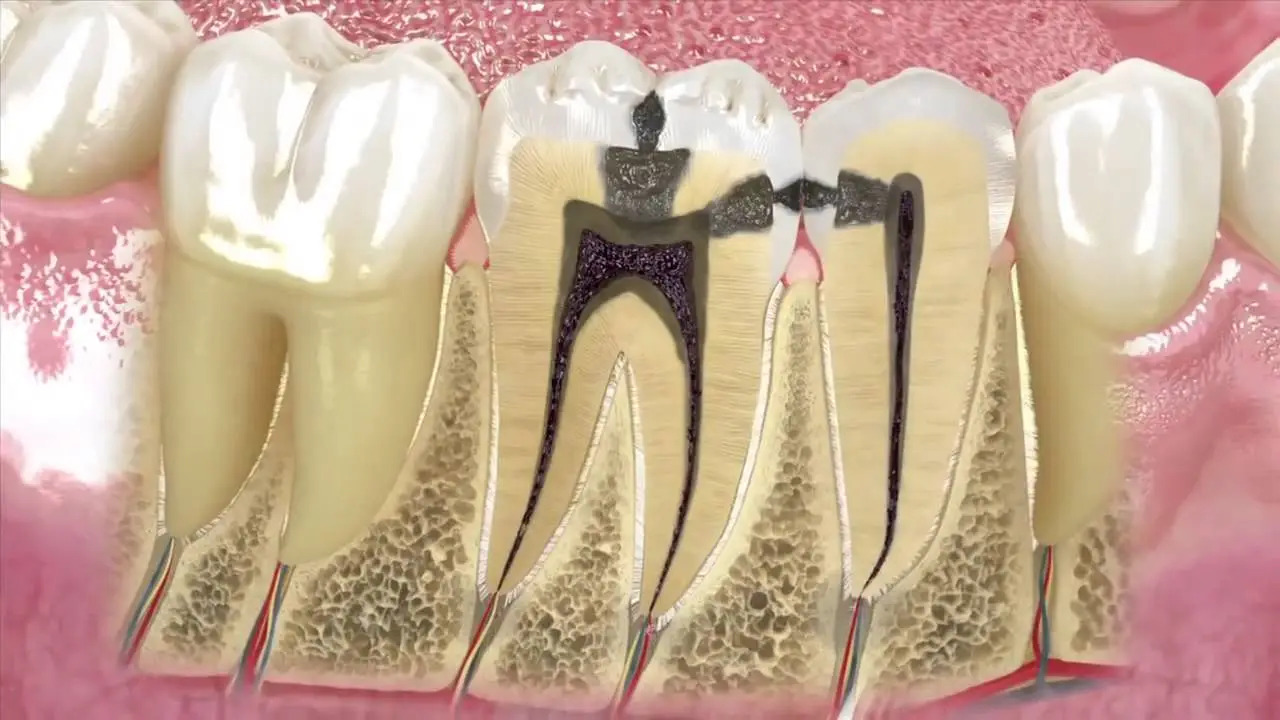
Caries on Adjacent Second Molars: The uncleanable space between a partially impacted wisdom tooth and the adjacent second molar traps food debris, causing deep root caries on the second molar that often results in the loss of both teeth.
Odontogenic Cysts and Bone Resorption: The developmental follicle surrounding a fully impacted tooth can fill with fluid, developing into dentigerous cysts that expand within the jawbone, destroying bone matrix and predisposing the jaw to pathological fractures.
Orthodontic Relapse and Crowding: Eruptive pressure from impacted third molars pushes anteriorly against the dental arch, inducing anterior crowding and compromising previous orthodontic results.
Chronic Oromandibular Pain: Pressure from impacted teeth frequently manifests as referred temporal headaches, earaches, and temporomandibular joint discomfort.
How Long Does Impacted Wisdom Tooth Extraction Take?
When evaluating how long does impacted wisdom tooth extraction take, operational time varies based on anatomical position, depth of impaction, root curvature, and bone density:
Erupted Wisdom Tooth Extraction: Takes approximately 10 to 20 minutes.
Partially Impacted Tooth Extraction: Requires 20 to 30 minutes.
Fully Bone-Impacted Tooth Surgery: Involves bone removal and tooth sectioning, taking approximately 30 to 45 minutes per tooth.
How Is Impacted Wisdom Tooth Surgery Performed?
The surgical protocol for impacted wisdom tooth surgery executed at Livera Dental Clinic follows these sequential steps:
Local Anesthesia and Sedation: The surgical site is fully anesthetized using modern local anesthetics. Intravenous sedation is available for anxious patients.
Mucoperiosteal Flap Elevation: A small incision is made in the gingival tissue to elevate a surgical flap and expose the underlying bone.
Bone Removal and Tooth Sectioning: To preserve adjacent bone and structures, the impacted tooth is sectioned into smaller fragments using ultrasonic piezo-surgical instruments and gently removed.
Debridement and Suturing: The surgical socket is thoroughly irrigated with sterile saline, and the mucosal flap is repositioned and secured with surgical sutures.
How Long Does Pain Last After Impacted Wisdom Tooth Extraction?
A primary concern following surgery is how long does pain last after impacted wisdom tooth extraction.
Mild to moderate discomfort begins as local anesthesia wears off 2 to 4 hours post-surgery.
Peak swelling and discomfort occur within the first 48 to 72 hours; this is effectively managed using prescribed anti-inflammatory medications.
Discomfort subsides significantly by day 4 and resolves completely within 7 to 10 days.
Warning (Alveolar Osteitis / Dry Socket): If severe, throbbing pain radiating toward the ear develops 3 to 4 days post-extraction and does not respond to analgesics, the primary blood clot may have dislodged. Contact the clinic immediately for socket dressing.
Post-Operative Guidelines After Impacted Wisdom Tooth Extraction
To ensure rapid, uncomplicated healing, observe these instructions after impacted wisdom tooth extraction:
Bite on the Gauze Pad for 30 Minutes: Maintain firm, constant pressure on the surgical gauze for 30 minutes. Do not spit; swallow your saliva. Spitting creates negative intraoral pressure that dislodges the blood clot and triggers secondary bleeding.
Dietary Restrictions for the First 24 Hours: Avoid hot, spicy, or hard foods. Consume soft, room-temperature or cold foods (such as yogurt, smooth soups, or purées).
Do Not Use Straws: Avoid suction forces that dislodge the blood clot.
Apply Cold Compresses: Apply an ice pack externally to the cheek for 10-minute intervals during the first 24 hours to minimize post-operative swelling and bruising.
Avoid Smoking and Alcohol: Tobacco smoke contains toxic chemicals that impair clot stabilization and increase dry socket risk fivefold. Avoid smoking for at least 72 hours.
Gentle Hygiene Protocol: After 24 hours, gently rinse your mouth with warm saline or prescribed antimicrobial mouthwashes.
Impaction Classification and Surgical Approach Matrix
Impaction Status | Clinical Presentation | Surgical Approach | Average Recovery Window |
Partially Impacted (Soft Tissue/Angular) | Recurrent operculitis, halitosis, local swelling | Surgical Extraction (Flap elevation & sectioning) | 5 to 7 Days |
Fully Impacted (Complete Bone Anchorage) | Asymptomatic or referred pressure pain, cyst risk | Complex Surgical Sectioning (Bone removal) | 7 to 10 Days |
Fully Erupted Third Molar | Functional or accessible caries | Simple Non-Surgical Extraction | 2 to 3 Days |
Acute Infection Present (Pericoronitis) | Severe trismus, facial swelling, systemic fever | Antimicrobial Pre-treatment + Delayed Extraction | 10 to 14 Days |
Frequently Asked Questions (FAQ)
Will I experience severe facial swelling and bruising after impacted wisdom tooth surgery?
Experiencing facial edema (swelling) and minor ecchymosis (bruising) along the jawline on days 2 and 3 post-surgery is a normal physiological tissue response. The extent of swelling depends on surgical complexity and individual tissue reactivity.
Is there a risk of nerve damage during lower impacted wisdom tooth extraction?
The roots of lower impacted wisdom teeth can lie in close proximity to the Inferior Alveolar Nerve, which provides sensation to the lower lip and chin. Conventional 2D radiographs can make assessing spatial relationships challenging.
When are sutures removed after impacted wisdom tooth surgery?
Suture removal depends on the material used. Resorbable sutures dissolve spontaneously within 10 to 14 days and do not require removal. If non-resorbable silk sutures are placed, you will return to the clinic 7 to 10 days post-surgery to have them removed. Suture removal is completely painless and takes only a few seconds.