Contentsexpand_more
- What is Clear Aligner Cleaning and Why is it Critical?
- How to Clean Clear Aligners: The Chronological Clinical Protocol
- Invisalign Aligner Cleaning: Brand-Specific Material Cautions
- Clean Stained Clear Retainers: Reversing Yellow Discolorations
- Selecting the Right Clear Aligner Cleaning Crystals and Devices
- Do's and Don'ts Matrix for Clear Aligner Maintenance
- Frequently Asked Questions (FAQ)
- Can I brush my clear aligners using regular toothpaste?
- Why do my clear aligners smell bad, and how can I eliminate this odor?
- My aligners are deeply stained; can I use bleach or rubbing alcohol to whiten them?
Eliminating the aesthetic burdens and structural limitations of traditional metal brackets, new-generation clear aligner systems (such as Invisalign) have revolutionized modern orthodontics. The primary clinical benefit of these clear aligner fields is their absolute visual discretion and the freedom to remove the appliances during meals. However, staying inside the oral cavity for approximately 20 to 22 hours a day, these biomedical devices are constantly exposed to saliva, organic debris, and the oral microbiome. Without a disciplined, scientifically verified clear aligner cleaning regimen, aligners rapidly accumulate bio-film, develop deep yellow discolorations, and produce an offensive intraoral odor.
A significant demographic of patients attempt to maintain optical transparency by utilizing random household chemicals, unknowingly inducing micro-structural deformation of the medical-grade plastic and compromising active tooth movement vectors. Muddy, discolored aligners lose their cosmetic advantage and lock cariogenic acids directly against the enamel matrix, accelerating tooth decay and localized gingival inflammation. At Livera Dental Clinic, our orthodontic specialists have generated this evidence-based manual outlining how to clean clear aligners, removing stubborn stains from retainers, and selecting professional aligner cleaning agents.
What is Clear Aligner Cleaning and Why is it Critical?
Every individual navigating clear aligner therapy must integrate structured clear aligner cleaning into their daily hygiene loops. This process targets the mechanical removal of the microscopic bacterial bio-film and salivary calcium deposits that steadily coat the thermoplastic matrices.
When aligners are left uncleaned, the humid environment of the mouth turns the plastic into a breeding ground for anaerobic pathogens. Over time, these formations crystallize, leading to structural cloudiness and halitosis. Furthermore, inserting a contaminated aligner over teeth traps destructive acids against the enamel, bypassing the natural washing mechanics of raw saliva.
How to Clean Clear Aligners: The Chronological Clinical Protocol
To preserve structural accuracy and optical clarity, follow this step-by-step protocol for how to clean clear aligners daily:
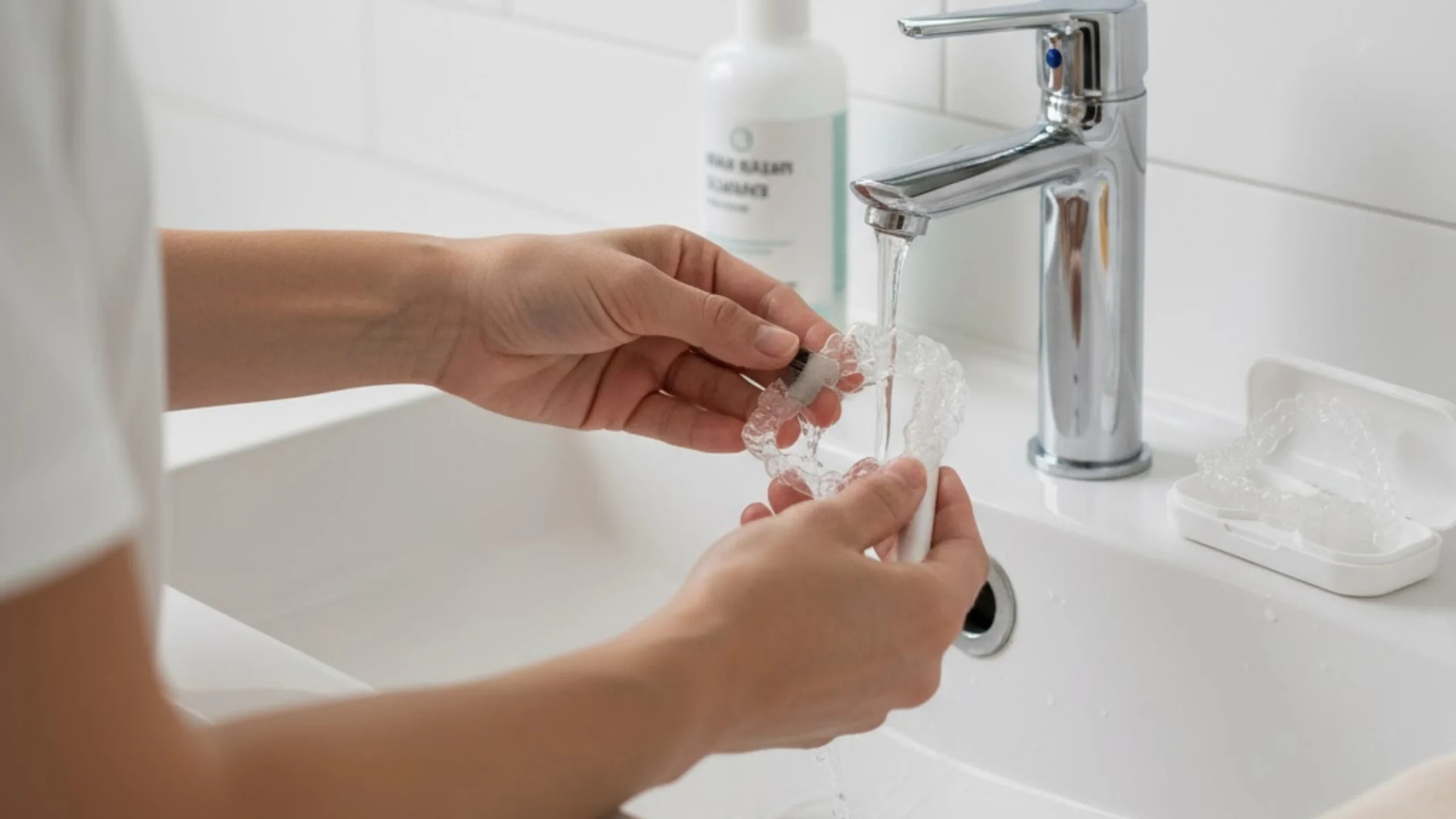
Immediate Lukewarm Rinsing: The moment you remove your aligners from the oral cavity, flush them thoroughly under running lukewarm tap water before the saliva has a chance to dry. Dried saliva leads to calcified white tartar stains that are highly difficult to clear mechanically.
Soft-Bristled Mechanical Brushing: Dedicate a separate soft-bristled manual toothbrush exclusively for your aligner maintenance. Brush both the internal structural indentations and external walls utilizing gentle, non-abrasive circular motions.
Non-Abrasive Liquid Cleansing: Apply a clear, fragrance-free liquid hand soap or gentle baby shampoo during the brushing sequence. Soap effectively dissolves lipids and disrupts bacterial walls without introducing structural scratches. Avoid all dyed soaps to prevent chemical pigment transfer. Rinse thoroughly with cold water.
Dehumidification and Ventilated Storage: Placing damp aligners directly inside a sealed protective case accelerates fungal and bacterial replication. Thoroughly dry the cleaned aligners using a clean paper towel and store them exclusively within a designated ventilated aligner case.
Invisalign Aligner Cleaning: Brand-Specific Material Cautions
Managing invisalign aligner cleaning requires specialized attention to preserve the molecular configuration of the proprietary "SmartTrack" thermoplastic matrix.
Invisalign aligners are engineered with specialized integrated elastic micro-modules calibrated to deliver constant, gentle forces. Consequently, boiling or hot water must never touch the aligners. High temperatures warp the thermoplastic matrix permanently, rendering the aligner unseatable and immediately halting your active orthodontic tracking.
For deep disinfection, utilize specialized "Invisalign Cleaning Crystals" 2–3 times weekly. Submerge the aligners within the effervescent bath for exactly 15 minutes to lift deep micro-stains and neutralize odors safely.
Clean Stained Clear Retainers: Reversing Yellow Discolorations
A primary patient complication is dealing with muddy, yellowed appliances. When addressing how to clean stained clear retainers, understand that yellowing stems from consuming colored fluids (coffee, tea, red wine) while the aligners are seated or inserting them over unbrushed teeth.
Clinical methods to clear yellow stains:
Effervescent Aligner Cleaning Tablets: Drop a specialized dental aligner cleaning tablet into a glass of lukewarm water. Submerge your stained aligners for 15 to 20 minutes. The chemical oxygenation action lifts deeply embedded organic stains and eliminates odor molecules from the porous plastic matrix.
Diluted White Vinegar Bath: As an organic at-home alternative, mix equal parts of white distilled vinegar and lukewarm water. Soak the appliances for 20 minutes to dissolve calcified tartar sheets and minimize yellowing. Rinse and brush gently post-soak. (Limit this protocol to once a week to protect the plastic integrity).
Selecting the Right Clear Aligner Cleaning Crystals and Devices
Navigating professional clear aligner cleaning crystals and sanitizing technologies requires selecting medical-grade options. Portable ultrasonic aligner cleaning baths utilize high-frequency sound waves to blast away micro-debris, bio-film, and early tartar scaling without manual handling; our department recommends these systems for daily care. Specialized sanitizing foams and sprays containing mild hydrogen peroxide lines serve as excellent on-the-go agents to quickly disinfect appliances during the workday.
Do's and Don'ts Matrix for Clear Aligner Maintenance
Authorized Maintenance Protocols (Do's) | Prohibited Mechanical Actions (Don'ts) |
Brush aligners twice daily using clear liquid soap and chilled or lukewarm water. | Expose aligners to boiling or scalding water, which warps the thermoplastic shape. |
Use specialized effervescent aligner cleaning tablets twice a week for deep sanitation. | Scrub aligners with standard toothpaste (abrasive particles scratch the surface, creating cloudiness). |
Always store aligners within their designated ventilated protective case when removed. | Wrap aligners in food napkins and leave them on tables (the leading cause of loss and accidental crushing). |
Always remove aligners before consuming any fluid other than plain, cold water. | Smoke, vape, or drink hot coffee/tea with aligners seated (triggers instant yellow staining and odor retention). |
Frequently Asked Questions (FAQ)
Can I brush my clear aligners using regular toothpaste?
No, you must never brush your clear aligners with standard toothpaste. Toothpastes are formulated with microscopic abrasive particles (measured as Relative Dentin Abrasivity or RDA factors) engineered to mechanically scrub away stains from hard enamel. While safe for teeth, these abrasives cut thousands of microscopic scratches into the softer medical plastic surface of the aligner. These micro-scratches permanently destroy optical clarity, creating a foggy, matte appearance. Furthermore, these rough surfaces provide an ideal environment for bacteria to anchor themselves, causing the appliance to stain and smell much faster.
Why do my clear aligners smell bad, and how can I eliminate this odor?
The unpleasant odor originating from clear aligners is driven by the accumulation of volatile sulfur compounds produced by anaerobic bacteria multiplying within the uncleaned bio-film and dried saliva layers coating the plastic. As saliva dries on the non-porous surface, it creates a stagnant protein matrix where odor-producing bacteria thrive. To eliminate this halitosis completely, brush your aligners daily using clear, non-abrasive liquid soap and submerge them in effervescent aligner cleaning solutions multiple times a week. Additionally, ensure you thoroughly brush your teeth and tongue before reseating the appliances.
My aligners are deeply stained; can I use bleach or rubbing alcohol to whiten them?
Absolutely not. Utilizing harsh household chemicals such as bleach, rubbing alcohol, hydrogen peroxide solutions designed for surfaces, or dish soaps to clear stains from clear aligners is highly dangerous. These aggressive chemicals chemically dissolve the medical-grade polyurethane matrices, causing the plastic to become brittle, crack, and prone to breaking. Furthermore, porous plastics can absorb toxic chemical residues, which are then slowly released directly into your oral mucosa during daily wear. For yellowing, utilize only approved medical aligner tablets or a brief, highly diluted white vinegar soak.