Contentsexpand_more
- What is an All-on-6 Implant?
- How is the All-on-Six Implant Technique Performed?
- What is the Difference Between All-on-4 and All-on-6?
- Key Advantages of the All-on-6 System
- Understanding All-on-6 Implant Cost Determinants in 2026
- Comparison Matrix: All-on-4 vs. All-on-6 Protocols
- Frequently Asked Questions (FAQ)
- Is the All-on-6 surgical procedure painful?
- How do I clean and maintain an All-on-6 fixed bridge?
- Will All-on-6 dental implants last a lifetime?
Complete edentulism or terminal dentition severely diminishes chewing efficiency, accelerates facial aging through bone resorption, and compromises oral function. Conventional removable full dentures frequently slip during mastication, cause speech impediments, and cover the palate, diminishing taste perception. Within modern full-arch surgical prosthodontics, the clinical standard for immediate full-mouth fixed restoration is the All-on-6 implant system.
Anchoring six titanium fixtures into strategic anatomical zones establishes load distribution, halts alveolar bone loss, and delivers functional biting efficiency.
What is an All-on-6 Implant?
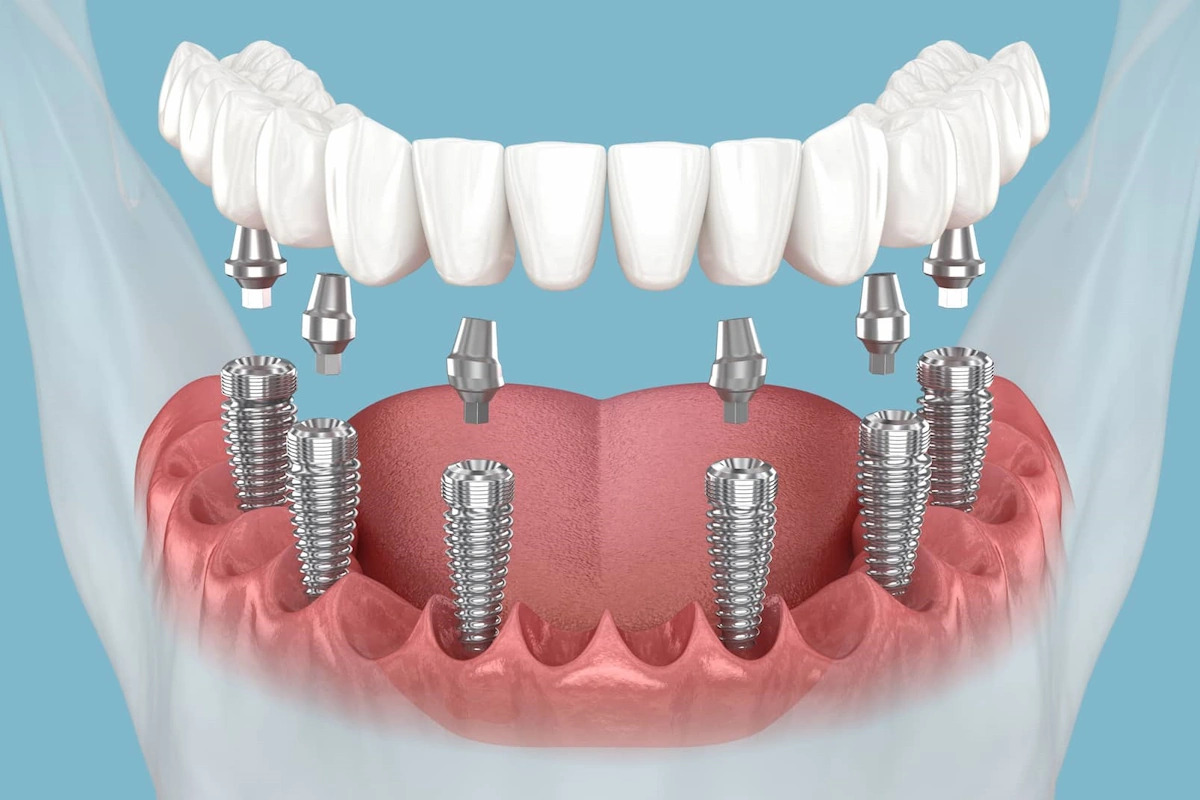
In contemporary oral implantology, the medical definition of what is an All-on-6 implant is: A surgical and prosthodontic rehabilitation protocol placing six endosseous titanium implants into an edentulous maxilla or mandible to support a fixed, screw-retained full-arch prosthetic bridge containing 12 to 14 teeth.
The protocol positions four anterior axial implants alongside two posterior tilted implants angled up to 30–45 degrees. Angling the posterior fixtures bypasses anatomical hazards such as the maxillary sinus cavities and the inferior alveolar nerve canal, eliminating the need for bone grafting in most cases.
How is the All-on-Six Implant Technique Performed?
The clinical workflow executing the All-on-six implant technique at Livera Dental Clinic follows these sequential steps:
3D CBCT Imaging and Digital Planning: High-resolution Cone Beam Computed Tomography maps bone density, ridge width, and neurovascular pathways. Virtual implant positioning is pre-planned using guided surgery software.
Surgical Placement: Under local anesthesia or IV sedation, non-restorable teeth are extracted. Using precision CAD/CAM surgical guides, six implants are placed into prepared osteotomies with high primary stability.
Same-Day Immediate Loading (Temporary Fixed Teeth): When insertion torque exceeds 35–45 Ncm, multi-unit abutments are secured, and a rigid, screw-retained provisional acrylic bridge is fitted within 24 to 48 hours. Patients leave with functional fixed teeth.
Osseointegration Phase: A 3-month healing window allows structural bone integration while the patient functions comfortably with their provisional bridge.
Definitive Prosthesis Insertion: Final digital impressions capture soft tissue architecture to mill a definitive full-arch bridge fabricated from monolithic zirconia, layered ceramic, or titanium-reinforced composite.
What is the Difference Between All-on-4 and All-on-6?
Comparing these two full-arch restorative modalities reveals key distinctions:
Load Distribution: All-on-6 uses six load-bearing anchors compared to four in All-on-4. Six fixtures distribute masticatory forces across a broader surface area, reducing stress per implant and enhancing long-term biomechanical safety.
Bone Volume Criteria: All-on-4 is indicated for patients with severe posterior bone atrophy where posterior bone volume is minimal. All-on-6 is ideal for patients with moderate-to-good posterior ridge height seeking maximum structural rigidity.
Maxillary Biomechanics: The maxilla possesses less trabecular bone density (Type III/IV bone) than the mandible. Placing six fixtures provides superior cross-arch stability in upper jaw rehabilitations.
Key Advantages of the All-on-6 System
Immediate Functional Stability: Complete extractions, implant surgery, and fixed teeth delivered within 24 hours.
Open-Palate Architecture: Completely leaves the upper palatal roof open, eliminating gag reflexes and restoring natural taste and thermal sensation.
High Chewing Efficiency: Restores over 90% of natural chewing capacity, enabling comfortable consumption of solid and firm foods.
Alveolar Bone Preservation: Transmits physiological occlusal loads to the jawbone, preventing disuse atrophy.
Understanding All-on-6 Implant Cost Determinants in 2026
Evaluating All-on-6 implant cost parameters involves case-specific variables:
Implant Brand Tier: Premium Swiss/German systems (e.g., Straumann, Nobel Biocare) versus standard regional brands.
Definitive Bridge Material: Custom-milled Monolithic Zirconia, Layered Zirconia, Titanium-Bar Reinforced Porcelain, or BioHPP polymers.
Adjunctive Surgical Procedures: Any required minor ridge preservation or local sinus floor lifts.
Digital Surgical Guide Fabrication: 3D-printed guided templates for minimally invasive, flapless surgical placement.
Comparison Matrix: All-on-4 vs. All-on-6 Protocols
Parameter | All-on-4 Protocol | All-on-6 Protocol |
Number of Fixtures | 4 Implants per Arch | 6 Implants per Arch |
Primary Indication | Severe posterior ridge atrophy | Moderate/Adequate bone volume |
Occlusal Force Distribution | Balanced across 4 points | Optimal (Even 6-point distribution) |
Maxillary Arch Suitability | Good | Superior (Ideal for softer bone) |
Immediate Loading Protocol | Yes (Provisional in 24 hrs) | Yes (Provisional in 24 hrs) |
Long-Term Rigidity | High | Maximum (Enhanced mechanical redundancy) |
Frequently Asked Questions (FAQ)
Is the All-on-6 surgical procedure painful?
No. The procedure is carried out under advanced local anesthesia or conscious sedation. The patient feels zero sharp discomfort during surgery. Post-operative swelling and mild soreness are managed using prescribed analgesics, anti-inflammatories, and cold compresses. Most patients resume regular non-strenuous routines within 48 hours.
How do I clean and maintain an All-on-6 fixed bridge?
Because the All-on-6 bridge is permanently screw-retained, you do not remove it at home. Daily maintenance requires brushing twice daily with a soft toothbrush, using an oral irrigator (water flosser) to flush under the pontic interface, and threading Superfloss between abutments. An annual clinical checkup allows the clinician to unscrew the prosthesis, clean it professionally, and inspect screw torque.
Will All-on-6 dental implants last a lifetime?
Yes. Titanium dental implants integrate biologically with living alveolar bone, providing lifelong service when maintained properly. Ensuring daily interproximal hygiene, avoiding smoking, and attending biannual maintenance exams ensures the long-term survival of both implants and prosthetic superstructures.