Contentsexpand_more
- What is the Clinical Snoring Prosthesis Definition?
- What is a Snoring Prosthesis and How Does Its Biomechanical Architecture Operate?
- Does Snoring Appliance Work? Evaluation of Clinical Success Rates
- Which Doctor Makes Snoring Prosthesis Appliances?
- How to Use Snoring Prosthesis Devices: Optimal Maintenance Protocols
- Snoring Prosthesis Reviews: Understanding Patient Adaptation Profiles
- What is the Capital Investment Cost for Custom Oral Appliances in 2026?
- Does Insurance or Public Healthcare Cover Snoring Prosthesis Costs?
- Frequently Asked Questions (FAQ)
- Can a patient who is completely edentulous and utilizes full dentures wear a snoring prosthesis?
- Does an advanced snoring appliance permanently alter face shape or jaw alignment?
- What is the expected structural lifespan of a customized snoring prosthesis?
- Can a standard night guard fabricated for bruxism eliminate snoring?
High-quality, uninterrupted rest operates as the most fundamental biological necessity for the human body to achieve cognitive, neurological, and structural cellular regeneration. However, millions of individuals globally struggle with an insidious nocturnal pathology that drastically damages their own clinical wellness while sabotaging their partner's sleep: Chronic snoring and obstructive sleep apnea (OSA).
Frequently misconstrued as a benign acoustic nuisance, snoring serves as a direct clinical indicator of upper airway obstruction and systemic nocturnal hypoxia (oxygen depletion). Following diagnostic sleep laboratory screenings executed by Otolaryngologists (ENT) and Neurologists, patients who reject invasive airway surgeries or present intolerance to CPAP (continuous positive airway pressure) masks can access an elite alternative in contemporary dental medicine. Fabricated via bio-compatible materials, a snoring prosthesis stands as the most reliable oral appliance engineered to preserve open airways without interrupting deep sleep cycles.
What is the Clinical Snoring Prosthesis Definition?
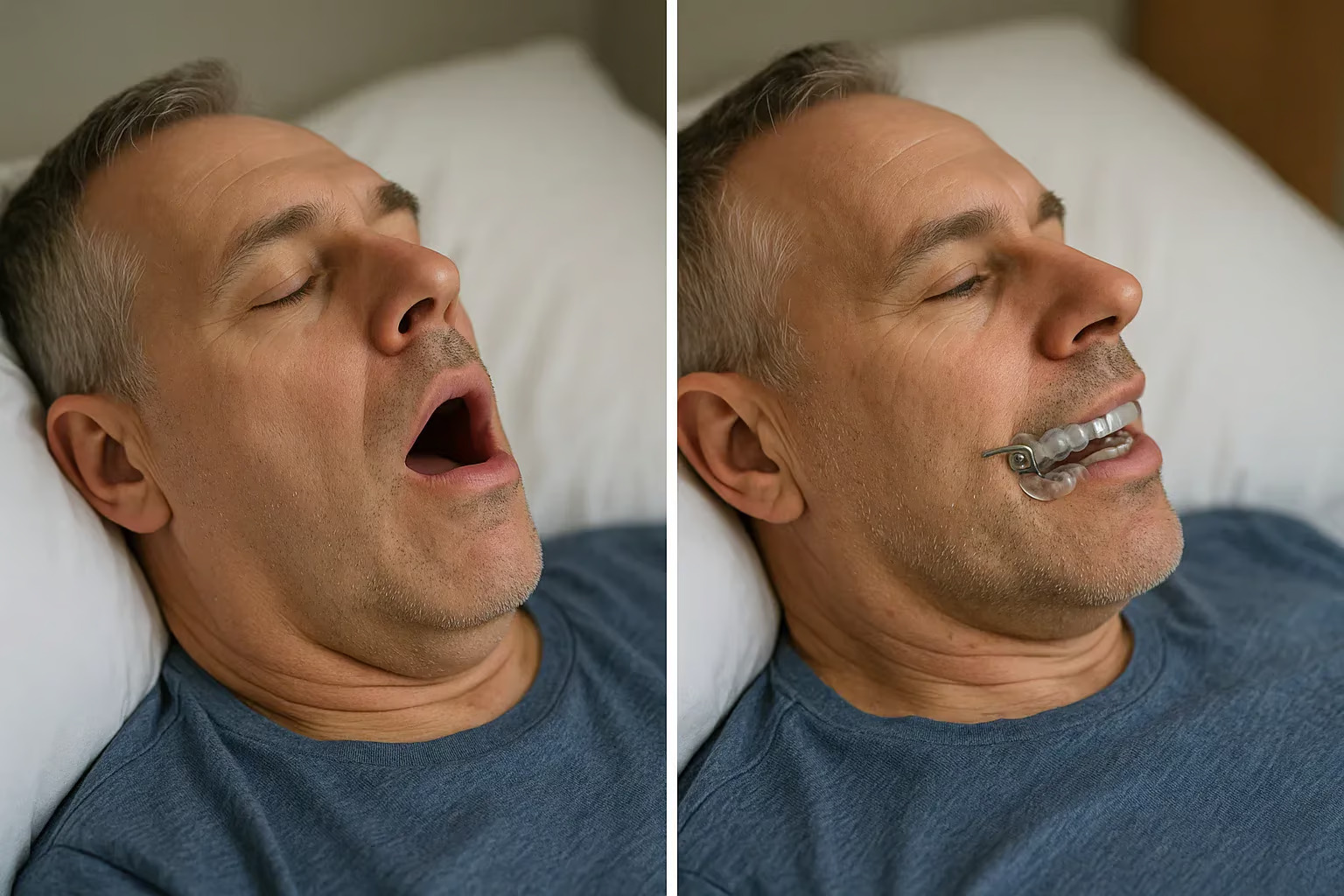
When the term prosthesis is introduced in dental medicine, patients routinely assume it describes replacing missing teeth with synthetic dentures. However, clarifying the explicit snoring prosthesis definition reveals a completely different therapeutic function: This device is a customized, dual-arch intraoral medical appliance fabricated for patients who possess full dentition with zero missing teeth.
It is not engineered to alter smile aesthetics; its singular structural objective is to mechanically biomechanically lock the mandibular and tongue anatomy into a stable forward position throughout the sleep cycle to keep the upper airway structurally expanded.
What is a Snoring Prosthesis and How Does Its Biomechanical Architecture Operate?
To adequately evaluate what is snoring prosthesis, one must analyze the muscular collapse that occurs within the pharyngeal space during sleep. Upon entering deep REM sleep phases, the neuromuscular tone of the tongue, soft palate, and pharyngeal walls experiences profound relaxation. This gravity-induced drop forces the tongue base to slip posteriorly while the lower jaw falls backward, severely narrowing the pharyngeal airway space. As inhaled air forces its way through this constricted zone, it triggers rapid friction and vibration of the relaxed soft tissues, generating the acoustic sound of snoring. If the collapse becomes total, airflow ceases for 10 seconds or longer, precipitating obstructive sleep apnea.
A snoring prosthesis works by locking the lower jaw millimetrically forward and slightly downward relative to its baseline position. Because the tongue musculature and surrounding pharyngeal soft tissues are anchored to the genial tubercles of the mandible, advancing the lower jaw directly pulls the entire tongue complex forward. This continuous mechanical traction increases the volumetric diameter of the posterior airway space. Air fluidly passes into the lungs with zero structural impedance, entirely eliminating both the acoustic snoring vibration and the acute suffocation risks of sleep apnea.
Does Snoring Appliance Work? Evaluation of Clinical Success Rates
During advanced consultations, patients regularly focus on a crucial question: Does snoring appliance work effectively?
Yes, absolutely. Extensive longitudinal clinical trials and the American Academy of Sleep Medicine (AASM) data confirm that high-grade, custom-fabricated snoring appliances achieve an 85% to 90% objective success rate in resolving mild-to-moderate obstructive sleep apnea and primary snoring.
The appliance terminates or drastically down-regulates acoustic snoring from the absolute first night of integration. Patients awaken reporting deep refreshment, zero morning tension headaches, and an end to daytime hypersomnolence (chronic fatigue). Within weeks, systemic concentration limitations and chronic exhaustion are fully mitigated.
Which Doctor Makes Snoring Prosthesis Appliances?
Navigating this therapeutic sequence requires a strict multi-disciplinary medical protocol. Patients frequently experience confusion regarding which doctor makes snoring prosthesis devices:
Diagnostic Phase: The diagnostic pipeline is handled exclusively by an ENT specialist, Pulmonologist, or Sleep Neurologist who coordinates an overnight Polysomnography (PSG) study within a certified sleep laboratory. This test quantifies the patient's specific Apnea-Hypopnea Index (AHI).
Fabrication Phase: Once the sleep study confirms mild-to-moderate OSA, the clinical execution shifts directly to an Orthodontist, Maxillofacial Surgeon, or Prosthodontist. Capturing precision digital intraoral impressions, establishing the therapeutic intermaxillary jaw registration, and engineering the appliance to prevent temporomandibular joint (TMJ) compression is entirely the responsibility of the specialized dentist.
How to Use Snoring Prosthesis Devices: Optimal Maintenance Protocols
To preserve structural material integrity and maintain elite intraoral health, patients must carefully track the clinical steps of how to use snoring prosthesis devices:
Nocturnal Insertion: Following absolute compliance with toothbrushing and interdental flossing protocols, the appliance is retrieved from its dry vault and gently seated over the maxillary and mandibular arches using light vertical finger pressure. It remains in place strictly during sleep and is extracted immediately upon waking.
Decontamination Routine: Upon morning extraction, the appliance must be rinsed thoroughly under cool running water utilizing a soft-bristled brush without toothpaste (as abrasive toothpaste particles can micro-scratch the clinical thermoplastic surfaces). Once per week, submerge the device in water infused with effervescent orthodontic sanitizing tablets for deep decontamination.
Dry Storage: After thorough cleaning, dry the medical appliance completely and store it inside its ventilated protective case to prevent microbial colonization.
Snoring Prosthesis Reviews: Understanding Patient Adaptation Profiles
Analyzing the extensive clinical data and tracking snoring prosthesis reviews from patients treated at our department reveals clear, consistent adjustment milestones:
Initial Adaptation Milestones: Users routinely report minor transient symptoms during the first 3 to 5 days of integration, including mild morning jaw stiffness, localized dental pressure, and temporary hypersalivation (increased drooling). However, by the completion of the first week, the neuromuscular matrix fully adapts to the forward mandibular position, and complete nocturnal comfort is established.
Superiority Over CPAP Technology: Patients who previously struggled with bulky, noisy Continuous Positive Airway Pressure (CPAP) machines praise the snoring prosthesis for its total silence, compact boxer-guard size, and extreme portability during travel, reporting much higher compliance rates.
What is the Capital Investment Cost for Custom Oral Appliances in 2026?
Understanding the economic outline is a significant element of patient planning. The baseline snoring prosthesis price varies depending on the underlying structural connection mechanics (such as adjustable nylon titration links, lateral dual-block screws, or CAD/CAM milled titanium frameworks) and laboratory customization.
Per the current 2026 specialty clinic distributions, a high-grade, medically customized snoring appliance requires an investment ranging between 15,000 TL and 35,000 TL. Over-the-counter, standardized "boil-and-bite" sports mouthguards sold online must be strictly avoided, as non-customized generic appliances apply uncontrolled, non-scientific forces that can permanently damage the temporomandibular joint.
Does Insurance or Public Healthcare Cover Snoring Prosthesis Costs?
Patients tracking public healthcare subsidies frequently question: Does insurance cover snoring prosthesis fees?
The definitive answer under current SGK and general public health parameters is no.
While public healthcare provides structural coverage or partial subsidies for industrial CPAP respiratory machines following a certified sleep laboratory diagnosis, custom intraoral snoring appliances fabricated within specialized dental clinics are classified as custom-milled medical devices. Consequently, they are not covered under public insurance frameworks and must be financed privately by the patient.
Frequently Asked Questions (FAQ)
Can a patient who is completely edentulous and utilizes full dentures wear a snoring prosthesis?
No. Classic mandibular advancement appliances require a minimum threshold of stable, firmly anchored natural teeth on both arches to hold the device in position and successfully advance the jaw. It cannot function in a completely edentulous mouth. However, for patients possessing implant-retained overdentures, specific custom modifications can be structurally engineered.
Does an advanced snoring appliance permanently alter face shape or jaw alignment?
When custom-engineered following precise tracking of the patient's individual TMJ condylar pathways, a snoring prosthesis does not damage face shape or cause permanent malocclusion. While a minor sensation of dental misalignment is common for 10 minutes immediately following morning extraction, the jaw returns to baseline rapidly. Generic, non-custom appliances, however, pose a severe risk of permanent TMJ injury.
What is the expected structural lifespan of a customized snoring prosthesis?
When maintained utilizing appropriate cleaning protocols and kept clear of abrasive damage, a premium medical snoring prosthesis exhibits a clinical lifespan of approximately 3 to 5 years. Significant body weight fluctuations or extensive subsequent dental work (such as new multi-unit bridges or crowns) may alter the internal tooth contours, requiring a new device fabrication.
Can a standard night guard fabricated for bruxism eliminate snoring?
No, it cannot. Standard night guards engineered to treat teeth grinding are designed purely to act as a flat protective barrier to prevent enamel attrition; they lack the biomechanical components required to shift and hold the lower jaw forward. Therefore, a standard bruxism splint cannot expand the airway space and will not resolve snoring.