Contentsexpand_more
- What is Office Teeth Whitening?
- Home vs. Office Teeth Whitening: Crucial Clinical Differences
- How is Office Teeth Whitening Applied? Step-by-Step Clinical Sequence
- Session Timelines: How Long Does It Take and How Many Sessions Are Needed?
- Safety Evaluation: Is Office Teeth Whitening Harmful?
- Longevity Analysis: Is Office Teeth Whitening Permanent?
- What is the Capital Investment Cost for Professional Bleaching in 2026?
- Frequently Asked Questions (FAQ)
- Will office teeth whitening change the color of existing composite fillings, veneers or crowns?
- How many shades lighter can I expect my teeth to become?
- Does professional teeth whitening thin out or scratch the dental enamel?
An immaculate, bright, and vibrant white smile operates as one of the most structural boosters of self-confidence within contemporary social frameworks and corporate relationships. However, over time, the persistent consumption of chromogenic dietary substances like dark coffees, teas, red wine, along with tobacco utilization and natural chronological aging, triggers intrinsic and extrinsic discolorations within the crystalline enamel matrix. These deep stains cannot be lifted or dissolved using standard home tooth brushing routines or routine scaling prophylactics alone.
Within modern aesthetic dentistry, the premier professional protocol engineered to safely, efficiently, and dynamically brighten tooth shade within a minimal timeframe is office teeth whitening. Conducted strictly within a specialized clinical environment under direct dental supervision, this chairside procedure opens the tooth color by multiple shades, delivering the radiant smile our patients desire.
What is Office Teeth Whitening?
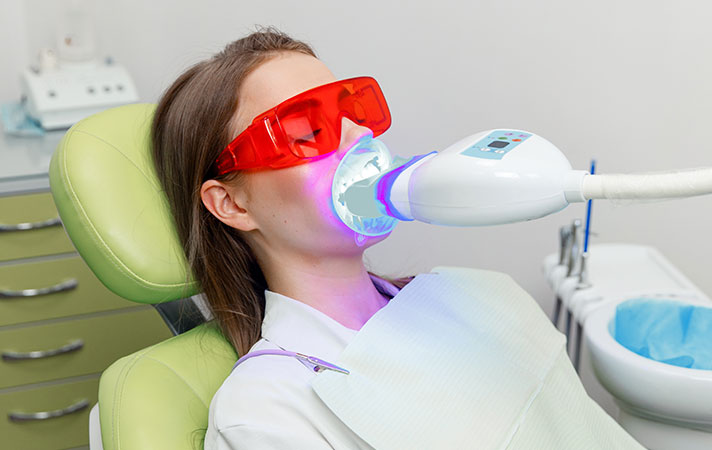
The clinical acceleration of enamel bleaching utilizing chemical oxidizing formulations is recognized as bleaching in professional literature. To accurately analyze what is office teeth whitening, one must evaluate the biological oxidation process. This procedure involves applying high-concentration bleaching gels (typically containing 25% to 40% hydrogen peroxide or carbamide peroxide) directly onto the enamel surfaces, followed by targeted activation utilizing specialized laser or high-intensity LED light sources.
The underlying mechanism relies on a controlled chemical oxidation reaction. As the active bleaching agent permeates the porous crystal prisms of the enamel, it releases highly reactive oxygen molecules. These oxygen molecules break down the complex, dark organic pigment chains trapped within the tooth matrix into smaller structures. This molecular alteration shifts the light-reflecting parameters of the enamel, rendering the tooth significantly whiter.
Home vs. Office Teeth Whitening: Crucial Clinical Differences
When exploring cosmetic smile transformations, patients frequently weigh different treatment modalities. The home vs office teeth whitening difference can be structured using three primary parameters:
Speed and Timeline Efficiency: Office teeth whitening delivers immediate, significant results within a single clinical hour. Conversely, home whitening requires capturing digital impressions to fabricate custom thermoformed clear trays; the patient must then manually apply low-concentration gels and wear the trays for several hours daily over a 1-to-2-week period.
Gel Concentration and Soft Tissue Safety: The professional bleaching materials utilized in office configurations are highly concentrated and powerful. To prevent chemical burns to the gingival margins, the clinician applies specific protective barriers. Home kits contain substantially lower peroxide concentrations and strength to ensure safety during self-application.
Continuous Professional Supervision: Chairside bleaching is continuously monitored by a specialized dentist, allowing for instant clinical modifications if acute dentinal hypersensitivity triggers during the sequence.
How is Office Teeth Whitening Applied? Step-by-Step Clinical Sequence
Office teeth whitening typically consists of the following steps:
1. Comprehensive Oral Prophylaxis and Screening: Prior to the bleaching sequence, the dentition undergoes a professional dental cleaning (scaling and polishing) to remove all extrinsic stains and plaque. If active caries or severe gingival recession are diagnosed, these pathologies are treated beforehand to prevent the gel from leaking into internal vital structures and causing pain.
Gingival Barrier Isolation: A specialized medical cheek retractor is adapted to isolate the working field. Next, a light-cured liquid protective resin barrier (gingival dam) is carefully extruded along the entire scalloped gingival margin to fully protect the soft tissues from chemical exposure.
Gel Application and Laser Light Activation: The premium concentrated peroxide gel is evenly distributed across the labial surfaces of the anterior teeth. A specialized dental laser or high-power blue LED light is then directed at the arches to activate the catalyst within the gel, accelerating the oxidation reaction.
Cycling and Post-Treatment Desensitization: The gel is left to react over a 15-minute sequence, after which it is suctioned away and replaced with a fresh layer. This cycle is typically executed 2 to 3 times within the same visit. Finally, all barriers are removed, the site is rinsed, and advanced topical remineralization treatments (fluoride varnishes) are layered to calm the enamel.
Session Timelines: How Long Does It Take and How Many Sessions Are Needed?
How long does office teeth whitening take: Incorporating the initial isolation protocols, gingival barrier curation, three 15-minute active oxidation cycles, and final desensitizing therapies, the comprehensive timeline finishes between 45 to 60 minutes. Patients successfully walk out with an entirely transformed smile in under one hour.
How many sessions for office teeth whitening: For over 90% of clinical presentations, a single appointment is fully sufficient to achieve our target shade goals (averaging an opening of 2 to 6 shades). However, for individuals presenting with highly resistant intrinsic staining, such as severe developmental fluorosis or deep antibiotic bands, a secondary or third follow-up session may be scheduled one week apart.
Safety Evaluation: Is Office Teeth Whitening Harmful?
When conducted under strict clinical protocols utilizing premium materials, the answer to is office teeth whitening harmful is a definitive no. Modern, medical-grade bleaching formulations do not micro-abrade, dissolve, or permanently compromise the structural mineral density of dental enamel.
However, during the active cycling and for the initial 24 to 48 hours following the procedure, experiencing mild-to-moderate transient dentinal hypersensitivity is a normal biological response due to open micro-pores. This sensitivity is effectively stabilized utilizing our specialized post-bleaching mineral pastes and completely dissipates within 2 days.
Longevity Analysis: Is Office Teeth Whitening Permanent?
Understanding the physical lifespan of the aesthetic outcome is essential. Providing a medical claim that is office teeth whitening permanent is scientifically incorrect, as enamel operates as a living, porous structure subject to continuous environmental exposure. The typical lifespan of a chairside bleaching treatment ranges between 1.5 to 3 years. Preserving this shade completely relies on the patient’s home hygiene and dietary compliance.
To maintain maximum shade stability, patients must strictly adhere to a "White Diet" protocol during the first week post-treatment, while the enamel micro-pores fully re-mineralize and close:
Do not consume dark, highly pigmented liquids, including specialty black teas, artisanal coffees, colas, red wines, or turnip juices.
Avoid foods rich in natural or synthetic colorants, such as tomato pastes, soy sauces, curry powders, pomegranate molasses, dark chocolates, and sour cherries.
Abstain entirely from smoking or utilizing tobacco products, as open enamel pores will absorb nicotine molecules rapidly, resulting in immediate yellow relapse.
What is the Capital Investment Cost for Professional Bleaching in 2026?
The precise financial blueprint associated with this treatment is dictated by the specific manufacturing technology utilized, the activation laser wavelength, and whether a single-arch or full-mouth restoration is indicated. The baseline office teeth whitening price is calculated using the 2026 Turkish Dental Association (TDB) fee schedules integrated with the premium operational standards of specialized aesthetic departments.
Utilizing uncertified, non-regulated "over-the-counter" or beauty-salon bleaching kits lacking medical diagnostics poses a severe risk of permanent chemical enamel burns, severe soft tissue ulcerations, and irreversible pulpal inflammation requiring root canal treatment. A definitive financial breakdown is structured following a complimentary aesthetic screening at our clinic.
Frequently Asked Questions (FAQ)
Will office teeth whitening change the color of existing composite fillings, veneers or crowns?
No, it will not. Bleaching formulations interact strictly with the organic carbon bonds of natural tooth enamel. Synthetic restorative materials such as composite resins, porcelain veneers, and zirconium crowns are completely non-reactive to peroxide oxidation. If you possess prominent front restorations, they may require cosmetic replacement following your bleaching session to match your new, brighter enamel shade.
How many shades lighter can I expect my teeth to become?
The specific shade progression relies on the patient's baseline mineral configuration and the structural source of the initial discoloration. On average, a standard professional chairside session opens the dentition between 2 to 6 shades. The final shade achieved at the end of the appointment represents the absolute physiological threshold of your natural enamel.
Does professional teeth whitening thin out or scratch the dental enamel?
No, absolutely not. Professional bleaching gels do not act as mechanical abrasives or coarse abrasives. They do not remove or shave down any volume of the enamel surface. The mechanism relies entirely on penetrating the micro-pores to dissolve trapped pigment compounds via controlled oxygenation, preserving the thickness of your natural tooth structure.