Contentsexpand_more
- What is a Hybrid Prosthesis?
- Why Choose an Implant Supported Hybrid Prosthesis?
- Types of Hybrid Prosthesis
- Advantages of a Zirconia Hybrid Prosthesis
- How is a Hybrid Prosthesis Made?
- Maintenance and Oral Hygiene for Hybrid Restorations
- Factors Influencing Hybrid Prosthesis Cost
- Comparison Matrix: Hybrid Prosthesis vs. Alternative Restorations
- Frequently Asked Questions (FAQ)
- Is the procedure painful when getting an implant supported hybrid prosthesis?
- Will my hybrid prosthesis look like natural teeth or be noticeable as false teeth?
- Does food get trapped underneath a hybrid prosthesis, and can it cause bad breath?
In cases of prolonged edentulism, the absence of functional mechanical stimulation causes rapid alveolar bone resorption. This extensive vertical and horizontal bone loss deprives the patient of not only teeth but also underlying alveolar bone height and soft tissue support, causing facial collapse and premature perioral aging. Conventional crown-and-bridge restorations are ill-suited for severe ridge resorption because they necessitate unphysiologically long dental crowns that appear bulky and unnatural. The definitive prosthodontic solution to simultaneously reconstruct missing teeth, lost bone volume, and the pink gingival architecture is an implant supported hybrid prosthesis.
Commonly referred to as a screw-retained fixed denture, this restoration is firmly anchored to endosseous implants and cannot be removed by the patient; however, it remains retrievable by a clinician for scheduled maintenance.
What is a Hybrid Prosthesis?
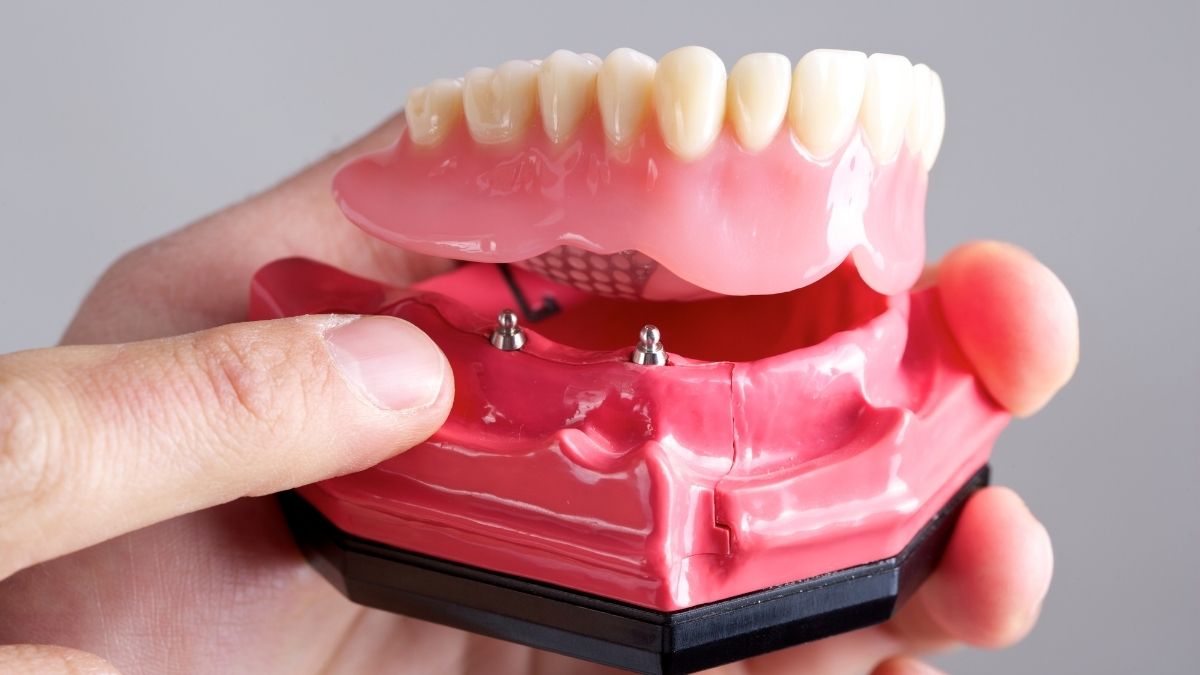
In clinical prosthodontics, the operational definition of what is a hybrid prosthesis: A full-arch, screw-retained fixed dental restoration supported by 4 to 6 dental implants that incorporates a rigid internal framework (milled titanium or zirconia), artificial prosthetic teeth, and an acrylic or ceramic pink gingival component replacing lost alveolar architecture.
The term "hybrid" reflects its combined nature: it marries the rigid stability, chewing efficiency, and non-removable security of fixed crown work with the facial tissue support and pink gingival aesthetics of a denture. The restoration cannot be dislodged by the patient, providing the confidence of natural dentition.
Why Choose an Implant Supported Hybrid Prosthesis?
Selecting an implant supported hybrid prosthesis over alternative rehabilitations is driven by specific biological and biomechanical indications:
Compensation for Severe Alveolar Resorption: When substantial vertical bone height has been lost, standard fixed bridges look unesthetic due to elongated clinical crowns. A hybrid restoration utilizes pink aesthetic porcelain or composite to mask ridge defects and restore lip fullness.
Correction of Angled Implant Trajectories: In All-on-4 or All-on-6 protocols, posterior implants are tilted to avoid anatomical boundaries like the maxillary sinuses or mental foramina. Multi-unit abutments and the hybrid framework redirect the screw access channels to non-aesthetic lingual or occlusal zones.
Screw-Retained Retrievability Without Cement: The entire prosthesis is anchored mechanically via prosthetic retention screws. This eliminates the risk of residual subgingival cement, a primary cause of peri-implantitis, while enabling easy removal by the dentist for maintenance.
Open Palatal Architecture: Eliminating coverage of the hard palate resolves gagging reflexes, enhances phonetic clarity, and preserves thermal perception and taste.
Types of Hybrid Prosthesis
Modern CAD/CAM manufacturing offers several distinct types of hybrid prosthesis:
Titanium-Bar Acrylic Hybrid (Classic Malo Protocol): Features a precision-milled titanium framework wrapped in high-impact acrylic resin with cross-linked composite prosthetic teeth. Provides shock-absorption against heavy occlusal forces.
Zirconia Hybrid Prosthesis: The contemporary benchmark in full-arch dentistry. Precision-milled from monolithic multi-layered zirconia discs with custom-glazed pink gingival ceramics. Highly resistant to chipping, wear, and staining, offering superior biomimetic translucency.
Titanium-Reinforced Porcelain Bridge: Combines a custom-milled titanium substructure with individual layered ceramic or zirconia crowns, yielding high aesthetic fidelity and structural rigidity.
BioHPP / PEEK Polymer Hybrid: High-performance polyetheretherketone (PEEK) framework veneered with specialized micro-hybrid composites. Its modulus of elasticity closely mimics human cortical bone, dampening heavy masticatory impact forces.
Advantages of a Zirconia Hybrid Prosthesis
Opting for a monolithic zirconia hybrid prosthesis provides several clinical benefits:
Stain and Wear Resistance: Unlike conventional acrylic teeth that wear flat or discolor over years of coffee and food exposure, monolithic zirconia remains impervious to chromatic changes.
Biocompatibility and Tissue Response: Highly polished zirconia surfaces resting against the soft mucosal ridge minimize bacterial adherence, lowering the incidence of mucosal inflammation.
Structural Integrity: Milled as a single continuous unit, individual tooth debonding is virtually eliminated compared to acrylic denture teeth set on metal frames.
How is a Hybrid Prosthesis Made?
The clinical and laboratory protocol detailing how is a hybrid prosthesis made involves systematic phases:
3D Virtual Planning and Surgical Placement: High-resolution CBCT scans guide the placement of 4 to 6 implants alongside multi-unit abutments to establish a parallel restorative baseline.
Immediate Provisional Loading: If insertion torque exceeds 35–45 Ncm, a rigid provisional screw-retained hybrid is delivered within 24 to 48 hours so the patient is never without teeth.
Osseointegration Period: A 3- to 4-month healing window enables structural bone remodeling around the titanium fixtures.
Digital Verification & Passive Fit Recording: An intraoral scan or open-tray impression records the precise implant spatial relationships. Passive fit is verified clinically to ensure zero strain on the bone-implant interface.
Aesthetic Try-In: Tooth positioning, vertical dimension of occlusion, and lip posture are evaluated using a 3D-printed prototype.
Definitive Torquing and Access Sealing: The final prosthesis is secured using calibrated torque drivers. Screw access channels are sealed with Teflon tape and light-cured composite resin matched to the occlusal anatomy.
Maintenance and Oral Hygiene for Hybrid Restorations
Because a hybrid restoration is permanently fixed in the mouth, patient compliance with daily home care is vital:
Daily Use of an Oral Irrigator (Water Flosser): A pulsating water flosser must be directed beneath the pontic base daily to flush away food debris and biofilm.
Specialized Interdental Floss (Superfloss): Thick-ended spongy floss is threaded beneath the titanium framework and around multi-unit abutments.
Annual Professional Maintenance: Once per year, your clinician unthreads the retention screws, removes the prosthesis, decontaminates the mucosal interface in an ultrasonic bath, assesses peri-implant health, and reseats the framework with fresh prosthetic screws.
Factors Influencing Hybrid Prosthesis Cost
Evaluating hybrid prosthesis cost parameters requires assessing individual anatomical complexity and restorative materials rather than a single fixed figure. Key variables governing cost include:
Number and System of Dental Implants: Whether the rehabilitation is planned over 4, 5, or 6 implants, and whether premium Swiss/German systems (e.g., Straumann, Nobel Biocare) or standard implant lines are selected.
Framework and Superstructure Materials: A traditional titanium-acrylic restoration carries different CAD/CAM milling and laboratory costs compared to a premium monolithic zirconia or BioHPP framework.
Multi-Unit Abutment Selection: Precision angled intermediate components required to correct implant divergence add to component expenses.
Pre-Surgical Bone Augmentation: The necessity of adjunctive procedures such as sinus lifts, ridge splitting, or localized bone grafting prior to implant placement.
Comparison Matrix: Hybrid Prosthesis vs. Alternative Restorations
Restorative Metric | Implant Supported Hybrid | Conventional Fixed Bridge | Removable Overdenture (Snap-On) |
Retention Mechanism | Screw-Retained (Fixed to patient) | Cemented / Screwed | Locator / Bar Snap-In (Removable) |
Severe Resorption Masking | Exceptional (Pink porcelain base) | Poor (Excessively long crowns) | Very Good (Acrylic flange) |
Masticatory Performance | Maximum (90–95% natural capacity) | Maximum (90–95%) | Moderate to Good (60–75%) |
Palatal Architecture | Completely Open (No gagging) | Completely Open | Partially Covered |
Mobility / Dislodgement | Zero | Zero | Minimal |
Clinical Maintainability | High (Easily unscrewed by doctor) | Low (Destructive removal) | High (Simple clip replacement) |
Frequently Asked Questions (FAQ)
Is the procedure painful when getting an implant supported hybrid prosthesis?
No. The implant placement and prosthodontic fitting procedures are conducted under advanced local anesthesia or conscious IV sedation. Patients experience zero intraoperative pain. Mild post-surgical tenderness and edema during the first 48 to 72 hours are managed with prescribed analgesics and cold compresses.
Will my hybrid prosthesis look like natural teeth or be noticeable as false teeth?
It will look completely natural. Modern hybrid prostheses are digitally designed using CAD/CAM software to match your facial midline, lip dynamics, and skin tone. The incorporation of lifelike monolithic zirconia and characteristically stained pink gingival ceramics ensures that the transition between your gums and the restoration is seamless and virtually undetectable.
Does food get trapped underneath a hybrid prosthesis, and can it cause bad breath?
The intaglio surface of a hybrid prosthesis is contoured to rest passively against the mucosa without excessive pressure. While microscopic food particles can navigate underneath, daily use of an oral irrigator (water flosser) and Superfloss easily flushes them out. Maintaining routine hygiene prevents bacterial stagnation and completely avoids halitosis.