Contentsexpand_more
- What is a Gingivectomy?
- What is the Clinical Difference in Gingivectomy vs Gingivoplasty?
- How is a Gingivectomy Done?
- What to Expect in the Gingivectomy Before and After Phase?
- Step-by-Step Instructions on Gingivectomy Aftercare
- Dynamic Stages of Gingivectomy Recovery
- Frequently Asked Questions (FAQ)
- How long does a gingivectomy take to heal completely?
- Does a gingivectomy hurt during or after the procedure?
- Will the excised gum tissue grow back after a gingivectomy?
An elite smile design requires significantly more than just white, perfectly aligned teeth. The precise scale, morphology, and color of the dentition represent only half of the aesthetic matrix; the level, symmetry, and vascular health of the gums that frame those teeth like a beautiful picture frame are equally fundamental. Some individuals complain that their gums show excessively during smiling (a condition known as a gummy smile), leaving their teeth looking abnormally short, or they may present with deep periodontal pockets triggered by chronic gum disease. These conditions compromise both periodontal health and professional social confidence.
Utilizing advanced surgical modalities in contemporary periodontics, these volumetric soft tissue excesses and anatomical irregularities can now be resolved seamlessly within minutes. The gingivectomy therapy engineered with digital precision safely resets the gingival margins to their ideal biological tiers, restoring cellular health while creating a balanced smile line. This comprehensive medical guide evaluates the surgical architecture, step-by-step aftercare instructions, and progressive recovery timelines behind aesthetic gum contouring.
What is a Gingivectomy?
The primary baseline query raised by our international patients upon micro-surgical screening is what is a gingivectomy. A gingivectomy is defined as the targeted surgical excision and complete removal of a specific portion of the gingival tissue. Medically, it is performed to excise the outer soft tissue wall of deep periodontal pockets arising from advanced periodontitis, which cannot be cleaned using routine home care tools. Aesthetically, it is utilized to excise hypertrophic, overgrown gum tissue covering the tooth crowns, effectively lengthening short clinical teeth and establishing an aligned smile frame.
What is the Clinical Difference in Gingivectomy vs Gingivoplasty?
Within general dental discussions, these two surgical terms are frequently used interchangeably or combined. However, checking the structural properties of gingivectomy vs gingivoplasty reveals critical differences in goal, execution, and outcomes:
Surgical Feature | Gingivectomy (Gum Removal) | Gingivoplasty (Gum Reshaping) |
Primary Objective | To surgically cut away and eliminate diseased, redundant, or hypertrophic gum tissue walls. | To sculpt, shave, and smooth the surface margins of healthy gum tissue for a natural contour. |
Medical Necessity | Mostly a medical necessity to lower deep pocket depths and eradicate localized bacterial shelters. | Primarily an elective, cosmetic procedure designed to balance asymmetrical gingival margins. |
Anatomical Target | Targets the bulk vertical depth of the loose or attached soft tissue wall. | Targets the delicate, scalloped marginal line framing the cervical neck of the enamel. |
Clinical Insight: For premium cosmetic results, these procedures are rarely executed in isolation. Our specialists routinely perform a coordinated combination; a gingivectomy removes the excessive mass, and a gingivoplasty refines the remaining borders into a highly natural, scalloped frame.
How is a Gingivectomy Done?
Contemporary advanced technologies have transformed soft tissue procedures into highly comfortable, outpatient experiences. So, how is a gingivectomy done within our specialized workflow?
Traditional Technique (Scalpel-Driven): The targeted gingival zones are fully desensitized utilizing advanced local anesthetics. The periodontist uses specialized micro-scalpels to execute precise milimetric incisions based on pre-mapped aesthetic lines. No sutures are required; however, a specialized protective paste (periodontal dressing) is layered over the raw tissue to cushion the healing site.
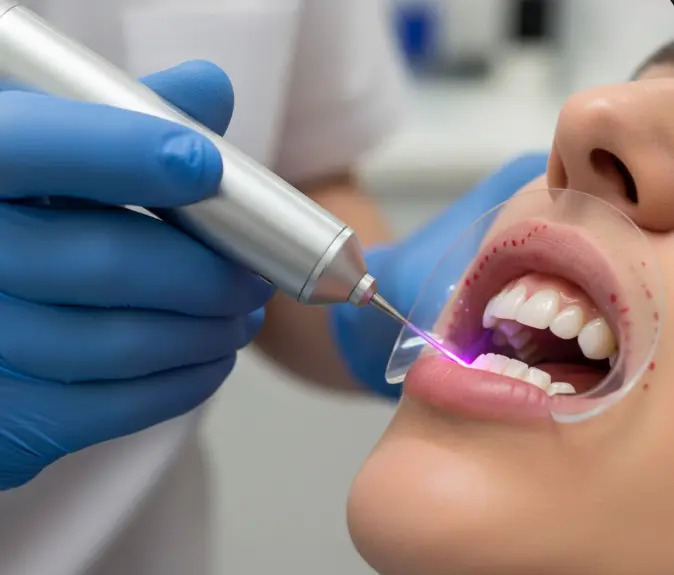
Contemporary Technique (Laser Gingivectomy): This represents the premium innovation preferred at Livera Dental Clinic. A laser gingivectomy completely avoids the use of cold steel blades. Specialized soft tissue laser beams vaporize the excess gingival tissue at a cellular level. As the laser cuts, it simultaneously seals open capillaries, ensuring that intraoperative and post-operative bleeding is virtually zero. The site is sterilized instantly, and healing progresses twice as fast as classical options.
What to Expect in the Gingivectomy Before and After Phase?
The definitive foundation of a stable clinical transformation rests on successfully navigating the gingivectomy before and after timeline:
The Before Phase: Establishing a clean oral baseline is mandatory. At least one week prior to surgery, the patient undergoes professional deep scaling and prophylaxis to clear calculus and minimize acute gingival edema. Operating on firm, stabilized tissues drastically enhances the precision of the incision line.
The After Phase: Immediately following completion, the teeth present an elongated, balanced appearance, and the scalloped margins are harmonized. Seeing a light crimson or white protective fibrin layer along the gum borders during the initial days is a normal biological phenomenon. The final structural smile architecture stabilizes upon complete soft tissue maturation.
Step-by-Step Instructions on Gingivectomy Aftercare
To maximize long-term tissue stability and experience a smooth recovery, the following gingivectomy aftercare guidelines must be followed closely:
Dietary Modulation Framework: Abstain from consuming any foods or liquids until the local anesthesia has worn off completely to prevent accidental, severe biting of the desensitized lip or tongue. For the first 3 to 5 days, avoid highly spiced, acidic, intensely salty, or burning-hot items. Hard, crunchy, or fibrous foods (such as chips, nuts, or popcorn) can lodge into the raw healing margins, sparking acute infections. Maintain a soft diet focusing on yogurt, purees, room-temperature soups, pasta, and soft eggs.
Oral Hygiene Modifications: Maintain routine brushing and flossing protocols across all non-treated regions of the mouth. Do not apply a manual or electric toothbrush directly onto the healing surgical gum margins for the first 7 days. Instead, sanitize the surgical site gently utilizing prescribed chlorhexidine-based antimicrobial mouth rinses or specialized clinical sprays.
Absolute Tobacco Cessation: Avoid smoking or using nicotine products for a minimum of 48 hours post-procedure. The toxic chemicals and high temperature of tobacco smoke cause severe peripheral vasoconstriction, starving the healing margins of vital oxygenated blood supply and increasing complication rates.
Physical Exertion Limitations: Rest and avoid strenuous physical labor, high-intensity cardiac exercise, or heavy lifting on the day of surgery. Keeping your heart rate at a baseline level prevents secondary capillary oozing at the surgical margins.
Dynamic Stages of Gingivectomy Recovery
Navigating gingivectomy recovery involves specific biological healing stages. During the initial 24 to 48 hours, slight capillary oozing and pink-tinted saliva are normal. By day 3, a gelatinous white-grey film routinely overlays the healing margins; this is not an infection or a food remnant, but rather a vital new epithelial tissue layer composed of a healing fibrin matrix. It must never be scraped or scrubbed away. By the end of the first week, this protective matrix sheds naturally, revealing a fresh, light-pink gingival surface below. Full maturation and collagen stabilization within the deeper connective tissue layers take between 1 to 3 months.
Frequently Asked Questions (FAQ)
How long does a gingivectomy take to heal completely?
On average, initial surface tissue healing following a gingivectomy takes 7 to 10 days to finalize. When the procedure is completed utilizing our advanced laser gingivectomy systems, this timeline can drop to a swift 4 to 5 days. Patients routinely return to professional and academic environments within 24 to 48 hours. The complete biological remodeling and final stabilization of the new gum line take approximately 4 weeks.
Does a gingivectomy hurt during or after the procedure?
No, a gingivectomy is completely painless. Prior to launching the treatment, advanced local anesthetics are administered to fully desensitize the target gingival quadrant; the patient feels absolute zero sharp pain or soreness during surgery. Once the numbing agents wear off a few hours later, a mild, dull tenderness or throbbing sensation is normal. This minor discomfort is easily managed utilizing basic over-the-counter anti-inflammatories like ibuprofen or acetaminophen.
Will the excised gum tissue grow back after a gingivectomy?
When a gingivectomy is executed within precise anatomical boundaries the excised gum tissue does not grow back; the cosmetic results are permanent. However, if excellent home oral hygiene is neglected, allowing severe bacterial plaque accumulation, or if the patient continues taking specific systemic medications that induce gum hypertrophy (such as certain blood pressure or anti-seizure drugs), the gingiva can overgrow again.