Contentsexpand_more
- What is an Amalgam Filling and Why is it Used?
- Are Amalgam Fillings Safe? What Are Their Advantages?
- What is the Lifespan of an Amalgam Filling?
- Are Amalgam Fillings Harmful or Banned?
- What Happens if it Breaks or is Swallowed?
- Can You Have an MRI with an Amalgam Filling?
- How are Amalgam Fillings Removed Safely?
- Frequently Asked Questions (FAQ)
- What modern alternatives can replace an amalgam filling?
- Should I replace my amalgam fillings purely for health reasons?
- Will I experience tooth pain after an amalgam filling is removed?
- Can amalgam fillings be removed during pregnancy?
One of the most deeply rooted, highly debated, and historically significant applications in dental medicine is the metallic restoration clinically classified as a silver amalgam filling. For over a century, these dense materials served as the definitive global standard for restoring extensive cavities in posterior teeth. However, with the rapid advancement of modern biomimetic materials, amalgam fillings are heavily scrutinized by patients today due to both their dark metallic aesthetic and their chemical composition. This comprehensive guide addresses every key question regarding amalgam restorations based on current clinical consensus and toxicological data.
What is an Amalgam Filling and Why is it Used?
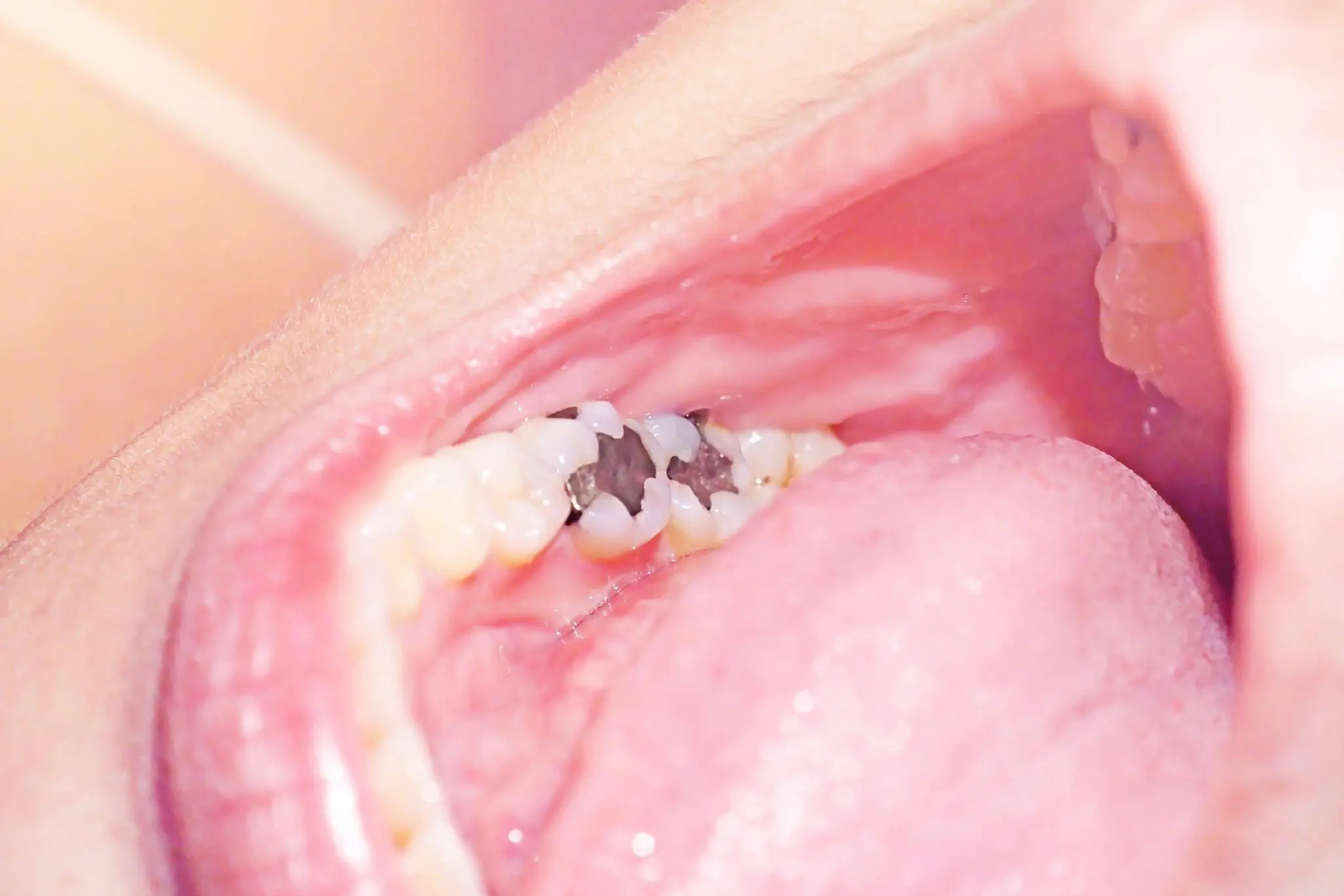
An amalgam filling is a specialized metallic compound utilized in clinical dentistry for nearly 150 years to restore large cavities in stress bearing molar teeth. Because of the distinct chemical interaction of its components, it exhibits a noticeable dark grey or blackish appearance on the tooth structure.
The fundamental answer to why are amalgam fillings used lies strictly in their extraordinary mechanical toughness. Decades ago, prior to the engineering of high strength composite resins capable of withstanding massive occlusal loads, silver amalgam was often the only clinical choice available to save structurally compromised molars. Chemically, it is created by combining a dry powder alloy with liquid elemental mercury. The alloy powder consists of:
Silver (40-70%): Provides high structural strength and controls expansion.
Tin (12-30%): Balances the setting reaction and controls dimensional shrinkage.
Copper (12-30%): Increases overall hardness and minimizes clinical corrosion.
Zinc (0-2%): Prevents oxidation and enhances material manipulation during placement.
Liquid Mercury (45-50%): Actively binds the alloy particles together, creating a plastic, highly malleable compound that hardens rapidly within the cavity.
Are Amalgam Fillings Safe? What Are Their Advantages?
While aesthetic demands have shifted modern dental practices away from metal restorations, the biomechanical longevity of amalgam cannot be dismissed. When evaluating whether an amalgam filling is good, from a purely mechanical perspective, the answer is affirmative. The primary clinical benefits include:
Exceptional Wear Resistance: Demonstrates unparalleled resistance to heavy chewing forces, outlasting many older generations of tooth-colored fillings.
Technique Insensitivity: Can be successfully placed in deep subgingival areas where complete moisture and saliva control is difficult to establish.
Cost Effectiveness: The operational costs associated with manufacturing and placing amalgam are significantly lower than laboratory-fabricated porcelain inlays.
What is the Lifespan of an Amalgam Filling?
Statistically, dental amalgam represents one of the most durable classes of restorative materials available. The definitive amalgam filling lifespan depends heavily on individual oral hygiene maintenance, parafunctional habits, and the overall volume of the cavity preparation.
The clinical answer to how long do amalgam fillings last averages between 10 to 15 years. However, in patients exhibiting excellent home care and zero bruksism, these silver restorations frequently remain fully functional for 20 to 30 years without developing secondary recurrent decay.
Are Amalgam Fillings Harmful or Banned?
The central point of concern regarding silver fillings stems directly from their mercury content. The question of whether an amalgam filling is harmful has remained a point of intense toxicological evaluation globally.
In its free, unbonded state, elemental mercury is a known heavy metal toxin. However, once an amalgam filling undergoes its full setting reaction, the mercury transforms into a chemically locked, stable metallic matrix. Leading public health organizations, including the World Health Organization (WHO) and the American Dental Association (ADA), affirm that fully intact, stable amalgam fillings do not release mercury at levels capable of causing systemic harm. However, trace amounts of mercury vapor are released during initial placement and, critically, during mechanical removal. For this reason, its use is heavily discouraged in pregnant women, individuals with compromised renal function, and young children.
Regarding whether amalgam fillings are banned, current regulations show that while there is no absolute global prohibition, countries across the European Union and signatories of the Minamata Convention on Mercury have severely restricted their application due to environmental safety. Most modern premium clinics no longer place new amalgam fillings, opting to replace existing ones with biocompatible materials upon patient request.
What Happens if it Breaks or is Swallowed?
Patients frequently encounter anxiety regarding structural failures or accidental ingestion of older dental restorations:
What happens if an amalgam filling breaks: A structural fracture compromises the marginal integrity of the restoration, causing micro-leakage. Bacteria easily infiltrate these marginal gaps, initiating secondary decay underneath the metal that is difficult to detect without radiographs. Furthermore, jagged metallic edges can cause chronic trauma to the tongue and buccal mucosa. While a fracture slightly elevates localized mercury vapor release, it does not cause acute poisoning; however, prompt replacement is highly recommended.
What happens if an amalgam filling is swallowed: Accidentally swallowing a small fragment of a broken amalgam filling typically does not present a medical emergency. The elemental mercury locked within the metal matrix does not dissolve easily in the highly acidic gastric environment and passes completely through the gastrointestinal tract unabsorbed. The primary clinical risk is not chemical toxicity, but rather the structural danger of aspiration into the respiratory tract.
Can You Have an MRI with an Amalgam Filling?
Pre-radiological screening frequently raises concerns regarding the presence of metallic intraoral compounds. The definitive answer to can you have an mri with an amalgam filling is safely yes.
Magnetic Resonance Imaging (MRI) scanners generate incredibly powerful magnetic fields. Fortunately, the specific non-noble and noble metals integrated into dental amalgam, such as silver, tin, and copper, are non-ferromagnetic. Consequently, an amalgam filling will not become dislodged, dislocated, or dangerously overheated by the magnetic pull of the scanner. The only minor technical side effect is localized image distortion (susceptibility artifacts) in immediate craniofacial scans, which radiologists can easily account for.
How are Amalgam Fillings Removed Safely?
At Livera Dental Clinic, we treat the extraction of old metal fillings with elite technical precision. The process of amalgam filling removal requires rigid adherence to protective protocols, as the mechanical drilling of metal generates elevated thermal energy and mercury vapor. We strictly execute the international SMART (Safe Mercury Amalgam Removal Technique) guidelines:
Complete Rubber Dam Isolation: The target tooth is completely isolated from the oral cavity using a specialized non-latex barrier, preventing the patient from inhaling or swallowing particulate metal debris.
High-Volume Evacuation Systems: Dual high-vacuum suction tips coupled with localized negative pressure air purification systems are deployed to capture airborne vapors instantly.
Sectioning Technique with Copious Irrigation: Rather than grinding the metal into fine dust, high-speed carbide burs are utilized to section the filling into large chunks. Copious cold water irrigation is maintained continuously to suppress thermal vapor release.
Supplemental Oxygen Delivery: Patients receive pure, supplemental oxygen via a nasal cannula throughout the entire drilling sequence to fully isolate them from room air.
Following successful removal, the cavity is meticulously sanitized and restored utilizing biocompatible nano-hybrid composite resins or CAD/CAM porcelain inlays, achieving complete structural harmony and natural aesthetics.
Frequently Asked Questions (FAQ)
What modern alternatives can replace an amalgam filling?
Advanced biomimetic dentistry utilizes high-density nano-hybrid composite resins that bond directly to the tooth structure, or custom-fabricated porcelain inlays and onlays that perfectly mimic natural enamel aesthetics and physical resilience.
Should I replace my amalgam fillings purely for health reasons?
If an existing amalgam filling exhibits perfect marginal adaptation, zero structural cracks, and no underlying secondary decay, routine removal is not medically mandatory. However, if you desire to eliminate the metallic look, it can be safely executed using our protective SMART protocol.
Will I experience tooth pain after an amalgam filling is removed?
Because removing a large metal filling requires high-speed sectioning, the vital dental pulp can experience mild thermal stimulation. Temporary post-operative sensitivity to hot or freezing stimuli is normal and typically subsides within a few days.
Can amalgam fillings be removed during pregnancy?
Unless an acute infection or emergency fracture occurs, elective removal of amalgam fillings is strongly discouraged during pregnancy and lactation. This precaution completely eliminates any unnecessary risk of fetal exposure to trace maternal mercury vapor.