Contentsexpand_more
- What is Fill Height and Occlusal Prematurity?
- Does a High Dental Filling Cause Pain?
- How to Tell If a Dental Filling is High
- What Happens If a Dental Filling is Too High?
- What Happens If a Dental Filling is Too Low?
- Will a High Dental Filling Wear Down on Its Own?
- How a High Filling is Adjusted in the Clinic
- When Does Pain Subside After a Filling Adjustment?
- Factors Influencing Treatment Cost
- Comparison Matrix: High vs. Balanced vs. Low Dental Filling
- Frequently Asked Questions (FAQ)
- How quickly can I tell if a new dental filling is too high?
- Does adjusting a high filling require an injection?
- Can a high filling resolve without professional adjustment?
Leaving your dental appointment, everything may appear completely comfortable. While local anesthesia numbs your lower jaw, you might tap your teeth together and answer: "It feels fine." However, several hours later, once mandibular block anesthesia fully dissipates and you attempt your first meal, an electric, sharp, stabbing pain shoots straight through that single tooth. If closing your mouth feels as though you are biting down onto an isolated pebble before any other teeth make contact, you are presenting with a clinical complication related to incorrect fill height (clinically diagnosed as an occlusal prematurity or high spot).
Natural human teeth are not rigid pegs fused statically into alveolar bone; each root is suspended by the periodontal ligament, a microscopic shock-absorbing apparatus rich in mechanoreceptors, sensory nerve fibers, and capillary loops. In a healthy physiological occlusion, bite loads disperse evenly across the arch. When a newly cured composite restoration remains elevated by mere fractions of a millimeter, hundreds of pounds of masticatory force concentrate on that single elevated spot. This biomechanical trauma compresses the periodontal ligament, inducing acute inflammation.
What is Fill Height and Occlusal Prematurity?
In restorative dentistry, the clinical definition of an incorrect fill height is: An occlusal restoration where the vertical dimension or anatomical cusp inclination of cured composite or amalgam exceeds the patient's habitual centric occlusion, establishing premature mechanical contact with the opposing tooth before maximum intercuspation.
Proprioceptive mechanoreceptors embedded within the periodontal ligament can perceive an elevation as thin as 20 to 30 microns (finer than a single human hair). Failing to equilibrate these high spots locks the functional chewing envelope, generating micro-trauma.
Does a High Dental Filling Cause Pain?
The direct answer to whether a high dental filling causes pain is: Yes, an elevated restoration provokes acute, sharp pain.
The pathological sequence develops as follows:
Acute Traumatic Periodontitis: Every time your jaw closes, the opposing cusp hammers the elevated restoration downward into the alveolar socket. The vascular suspensory fibers of the periodontal ligament are crushed, causing localized edema.
Severe Chewing Sensitivity: The tooth remains comfortable at rest; however, biting into soft bread elicits sharp pain.
Secondary Pulpal Hyperemia: Mechanical concussive trauma travels down the root apex, constricting neurovascular bundles entering the apical foramen. This produces secondary pulpitis, making the tooth sensitive to cold water and hot liquids.
How to Tell If a Dental Filling is High
Clinical markers indicating that a restoration exceeds physiological fill height:
Premature Impact Sensation: Closing your teeth gently causes the newly restored tooth to collide with the opposing arch before other teeth touch.
Pebble-Biting Pain: Masticating soft foods feels as though an unyielding foreign object is lodged between the occlusal tables.
Mandibular Deviation: You perceive your lower jaw shifting laterally or sliding uncomfortably to bypass the high contact point.
Morning Jaw Muscle Soreness: Unconscious nighttime clenching or bruxism against the interference leads to fatigue in masseter and temporalis muscle groups.
Lingual Ridge Irregularity: Tracing your tongue along the occlusal surface detects a sharp, raised ridge rather than smooth anatomical grooves.
What Happens If a Dental Filling is Too High?
Assuming that an occlusal interference will resolve without clinical care introduces notable risks:
Tooth or Cusp Fracture: Carrying the full load of masticatory force can fracture the composite material or shear off an adjacent natural enamel cusp.
Pulpal Necrosis (Loss of Tooth Vitality): Ongoing concussive trauma interrupts apical microcirculation, causing the tooth nerve to necrose over months and necessitating root canal therapy.
Alveolar Bone Resorption and Tooth Mobility: Chronic mechanical trauma induces localized bone remodeling and widened periodontal spaces, causing the tooth to loosen.
Temporomandibular Joint (TMJ) Dysfunction: Chronic avoidance shifts induce asymmetric condylar translation, resulting in TMJ clicking, disc displacement, and muscular headaches.
What Happens If a Dental Filling is Too Low?
A restorative contour beneath proper fill height presents distinct challenges:
Masticatory Inefficiency: Food boluses pass through without being ground, forcing unilateral chewing.
Over-Eruption of the Opposing Tooth (Extrusive Drift): Lacking an antagonist occlusal stop, the opposing natural tooth gradually drifts downward into the open clearance over several months.
Proximal Food Impaction: Undersized restorations often accompany inadequate contact points, allowing fibrous food to wedge into the interproximal papilla.
Will a High Dental Filling Wear Down on Its Own?
Addressing a common misconception:
Modern Resins Do Not Readily Wear Down: Contemporary nano-hybrid and bulk-fill composites exhibit high wear resistance similar to natural enamel. Self-abrasion can require months.
The Bone Adapts Before the Composite Wears: When patients report that discomfort subsided after weeks, the composite rarely wore down; instead, the tooth was driven into the alveolar bone or pulpal sensory fibers necrosed. Leaving an interference unchecked compromises biological support.
How a High Filling is Adjusted in the Clinic
At Livera Dental Clinic, correcting an elevated restoration is a routine, painless, 2-to-5-minute visit requiring no local anesthesia:
Articulating Paper Analysis: The dentist positions thin, dual-color articulating paper across the arch, instructing the patient to tap in centric occlusion and glide through excursive movements.
Targeted Mark Identification: High spots register as prominent target rings with clean centers, distinguishing prematurities from distributed contact points.
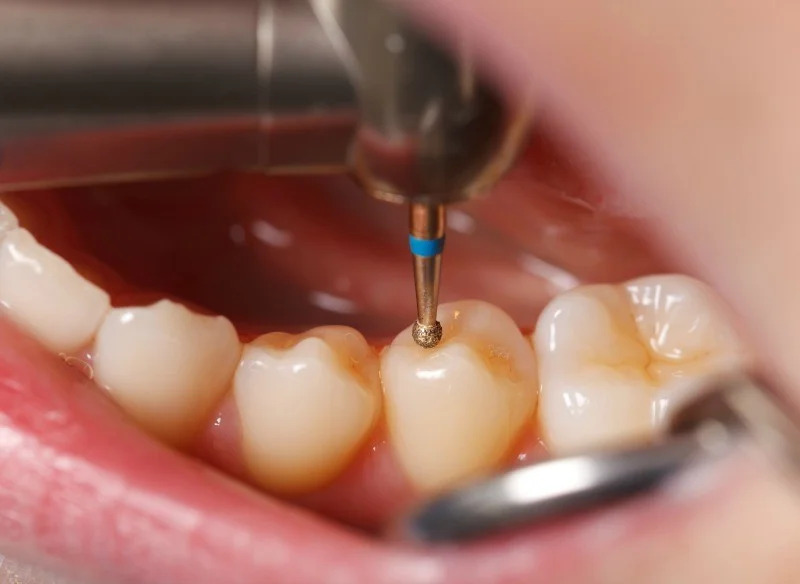
Micrometric Occlusal Relief: Fine-grit diamond or multi-fluted carbide finishing burs shave down the marked composite excess under water spray, preserving untouched natural enamel.
Re-verifying Balanced Occlusion: Occlusal contacts are checked to ensure uniform, bilateral contact distribution.
Polishing: The recontoured resin is finished with diamond-impregnated polishers to restore a smooth texture.
When Does Pain Subside After a Filling Adjustment?
Immediate Relief from Impact Shock: The sensation of jarring collision resolves immediately once the high spot is reduced.
Periodontal Ligament Recovery: Resolving crushed, inflamed periodontal ligament fibers requires 24 to 72 hours.
Extended Recovery in Delayed Cases: If a patient waited weeks before seeking relief, deeper periapical edema may require 1 to 2 weeks to settle completely.
Factors Influencing Treatment Cost
Health regulations prohibit advertising standardized clinical fees; costs depend on clinical circumstances:
Original Restoring Provider: Routine occlusal review and spot adjustments with the original clinician are typically included as post-placement care without separate fees.
External Second-Opinion Consultation: Attending an alternate clinical facility involves an occlusal diagnostic exam and adjustment fee.
Management of Advanced Trauma: If unaddressed occlusal trauma induced irreversible pulpitis, fees for endodontic therapy, fiber post reconstruction, or full-coverage crowns apply.
Comparison Matrix: High vs. Balanced vs. Low Dental Filling
Parameter | High Dental Filling | Balanced Dental Filling | Low Dental Filling |
Occlusal Timing | Premature contact before other teeth | Uniform, simultaneous contact | No occlusal contact |
Biting Sensation | Sharp, needle-like shooting pain | Comfortable, pain-free chew | Ineffective mastication |
Physical Perception | Sensation of a pebble between teeth | Natural integration | Sensation of a clearance gap |
Periodontal Status | Crushed fibers, ligament edema | Healthy physiologic support | Drift of opposing tooth |
Adjustment Time | 2 to 5 minutes with fine burs | No intervention required | Replacement of restoration |
Long-Term Risk | Cusp fracture, pulpal death, TMJ pain | Predictable, stable longevity | Arch collapse, food impaction |
Frequently Asked Questions (FAQ)
How quickly can I tell if a new dental filling is too high?
Local anesthesia typically takes 2 to 4 hours to wear off. While the lips and tongue remain numb, accurate occlusal perception is diminished. Once sensation returns and you chew your first meal, any premature contact will be readily apparent. If the tooth hits before your other teeth, contact your dentist for an adjustment.
Does adjusting a high filling require an injection?
No. Anesthesia is not needed. Composite filling material contains no sensory nerves; the adjustment merely removes a micro-layer of resin from the outer surface. The procedure is painless and takes only a few minutes.
Can a high filling resolve without professional adjustment?
No. High-strength composites resist rapid chewing wear. If discomfort subsides without treatment, it often indicates that the periodontal ligament widened, the tooth shifted under trauma, or the pulp lost vitality. Professional adjustment prevents these complications.