Contentsexpand_more
- What is an Embedded Canine Tooth?
- Can an Embedded Canine Tooth Erupt on Its Own?
- What Happens If an Embedded Canine Tooth Is Not Extracted or Treated?
- Embedded Canine Tooth Treatment Protocols
- 1. Surgical Exposure and Orthodontic Traction (The Gold Standard)
- 2. Embedded Canine Tooth Extraction (Surgical Removal)
- How Long Does Embedded Canine Tooth Braces Take?
- Post-Operative Care After Embedded Canine Tooth Surgery
- Comparison Matrix: Embedded Canine Management Modalities
- Frequently Asked Questions (FAQ)
- Is embedded canine exposure and button bonding surgery painful?
- Can an embedded canine tooth be brought down with braces in adult patients?
- What happens after an embedded canine tooth is extracted?
In oral anatomy, the maxillary canine (commonly termed the "eyetooth" or "cornerstone tooth") possesses the longest root, highest bone support, and dictates anterior smile aesthetics and canine-guided lateral disclusion. While canines normally erupt into the oral cavity around ages 10 to 12 following the exfoliation of primary teeth, they represent the second most frequently impacted teeth in the human skeleton following third molars. When physical crowding, premature loss of primary teeth, or ectopic eruption vectors prevent eruption, the tooth remains trapped within the palatal or alveolar bone as an embedded canine tooth.
Leaving an embedded canine untreated compromises smile symmetry and risks root resorption of adjacent lateral incisors, cyst formation, and functional malocclusion. Patients frequently ask: "Can an embedded canine tooth erupt on its own?", "Is surgical extraction or orthodontic braces better?", and "How long does embedded canine tooth braces take?" In this master guide compiled by Livera Dental Clinic orthodontists and maxillofacial surgeons, we evaluate what is an embedded canine tooth, embedded canine tooth treatment, embedded canine tooth braces, embedded canine tooth surgery, and embedded canine tooth extraction protocols.
What is an Embedded Canine Tooth?
In clinical orthodontics, the medical definition of an embedded canine tooth is: A permanent maxillary or mandibular canine that has failed to erupt into the dental arch within its expected physiological eruption window (ages 11 to 13) and remains locked within the palatal (palatally displaced) or labial (buccally displaced) alveolar bone.
Because canines form the "cornerstones" of the dental arch (canine eminence), they maintain lip fullness, support the alar base of the nose, and prevent posterior tooth wear during lateral masticatory excursions. Consequently, surgical preservation and orthodontic alignment remain the clinical gold standard over extraction whenever biologically feasible.
Can an Embedded Canine Tooth Erupt on Its Own?
Addressing whether an embedded canine tooth can erupt on its own:
If diagnosed early in patients aged 10 to 13 years and the impaction angle is favorable, interceptive extraction of the retained primary canine creates physical space, allowing the permanent canine to self-correct and erupt autonomously in 70% to 80% of cases.
However, if the patient is over 14 years old, the root apex is fully closed, or the tooth is positioned horizontally deep within the palatal vault, autonomous eruption is biologically impossible. Surgical exposure and orthodontic traction become necessary.
What Happens If an Embedded Canine Tooth Is Not Extracted or Treated?
Assuming that an asymptomatic embedded tooth requires no intervention carries significant clinical risks. What happens if an embedded canine tooth is not extracted or treated:
Root Resorption of Adjacent Incisors: The crown of the migrating embedded canine exerts pressure against the roots of adjacent central and lateral incisors, resorbing root structure and leading to early tooth loss.
Dentigerous Cyst Formation: The developmental dental follicle surrounding the impacted crown can expand with fluid, developing into odontogenic cysts that resorb large volumes of alveolar bone.
Temporomandibular Joint (TMJ) Dysfunction: Absence of canine-guided occlusion transfers lateral shear forces to posterior premolars and molars, contributing to TMJ disc displacement and joint strain.
Aesthetic Arch Asymmetry: Persistent retention of a small primary canine or permanent arch spacing shifts the dental midline.
Embedded Canine Tooth Treatment Protocols
Modern restorative dentistry approaches embedded canine tooth treatment through two main pathways: Orthodontic Alignment (Traction) or Surgical Extraction.
1. Surgical Exposure and Orthodontic Traction (The Gold Standard)
The preferred, biologically conservative approach when anatomical position permits:
Phase 1 (Space Creation): Fixed orthodontic appliances (braces or clear aligners) open sufficient arch width between the lateral incisor and first premolar.
Phase 2 (Embedded Canine Tooth Surgery / Exposure): Under local anesthesia, an oral surgeon creates a conservative surgical window (fenestration) in the palatal or labial mucosa to uncover the crown. An orthodontic bracket or eyelet button attached to a miniature gold chain is bonded to the enamel.
Phase 3 (Active Traction): The gold chain is connected to the archwire. Light, continuous orthodontic elastic traction guides the tooth through the bone at an average rate of 1 mm per month.
2. Embedded Canine Tooth Extraction (Surgical Removal)
Indicated when the canine is ankylosed (fused to bone), severe root dilaceration exists, or extensive resorption threatens adjacent teeth:
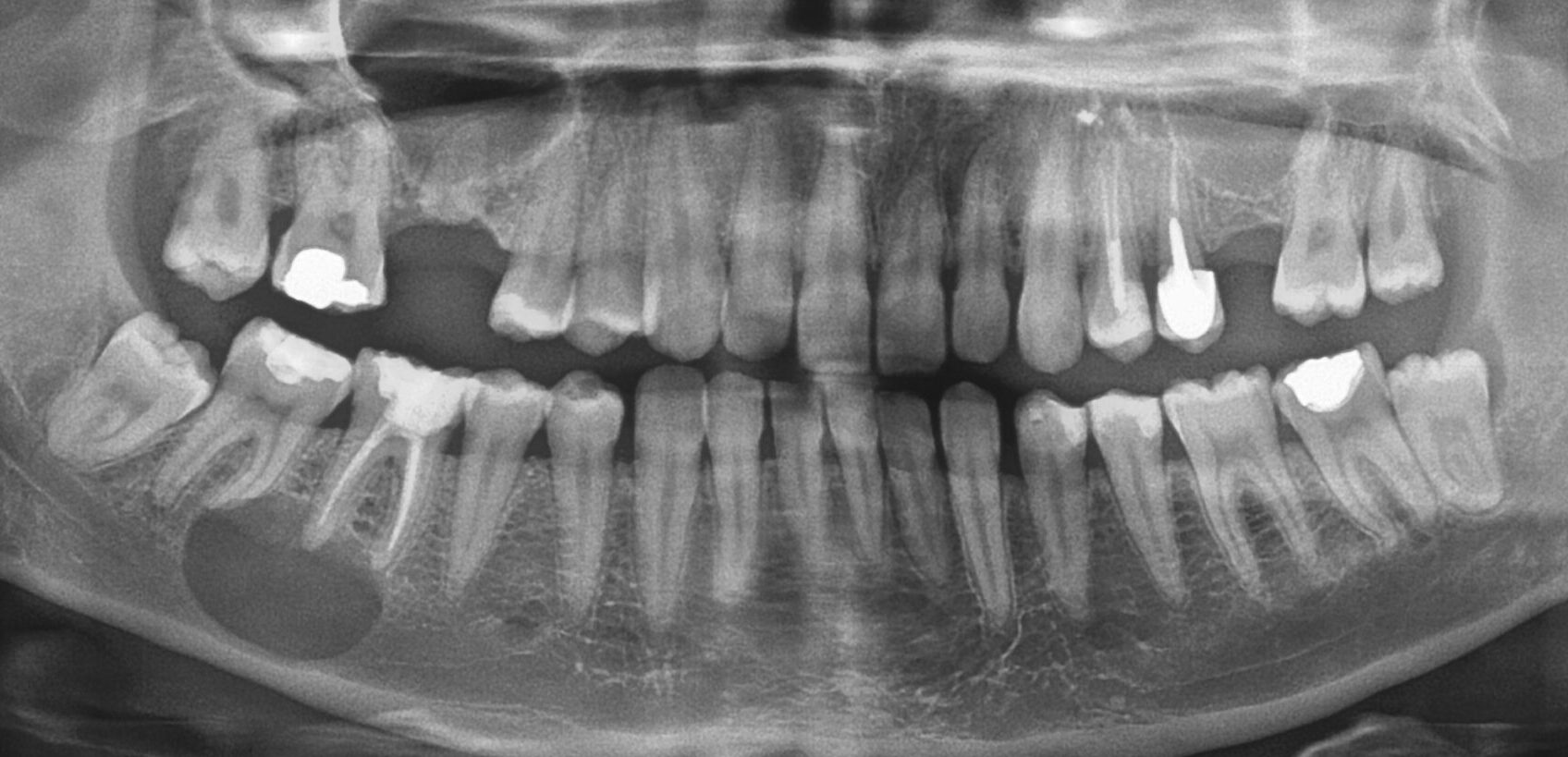
How is an Embedded Canine Tooth Extracted?: Utilizing high-resolution 3D CBCT imaging, the surgeon maps proximity to the incisive nerve and adjacent roots. Under local anesthesia or IV sedation, a palatal flap is elevated, and the tooth is sectioned and removed using piezosurgical instruments, followed by primary suturing. A dental implant is planned for the space.
How Long Does Embedded Canine Tooth Braces Take?
Evaluating how long does embedded canine tooth braces take depends on the depth, angulation, and distance to the occlusal plane:
Total Treatment Duration: Comprehensive orthodontic traction and final three-dimensional root torquing require approximately 18 to 24 months (1.5 to 2 years).
Guiding the crown through the palatal bone to the gingival margin requires 6 to 9 months; the remaining timeframe integrates the canine into the arch.
Post-Operative Care After Embedded Canine Tooth Surgery
Adherence to protocols after embedded canine tooth surgery ensures uneventful healing:
Intermittent Cold Compresses: Apply an ice pack externally to the cheek for the first 24 hours to control soft tissue edema.
Soft, Room-Temperature Diet: Consume smooth foods (soups, yogurt, purées) during the first 3 to 5 days; avoid hot, crunchy, or spicy foods.
Protect the Gold Chain: Do not pull, manipulate, or touch the exposed chain with your tongue or fingers.
Gentle Oral Hygiene: Refrain from vigorous rinsing for the first 24 hours; then introduce warm saline or prescribed chlorhexidine rinses.
Comparison Matrix: Embedded Canine Management Modalities
Clinical Parameter | Orthodontic Traction & Alignment | Surgical Extraction + Implant | Radiographic Monitoring Only |
Natural Tooth Preservation | 100% Retained | Sacrificed (Artificial implant) | Retained with persistent risks |
Treatment Timeline | 18 to 24 Months | 3 to 4 Months (Extraction + Implant) | Indefinite monitoring |
Adjacent Root Safety | Actively guided away from roots | Eliminates root contact | High risk of root resorption |
Aesthetic Emergence Profile | Superior (Natural gingival contour) | Very High | Progressive bone collapse |
Optimal Patient Cohort | Ages 12 to 25 Years | Severe ankylosis / Older adults | Medically compromised patients |
Frequently Asked Questions (FAQ)
Is embedded canine exposure and button bonding surgery painful?
No. Surgical exposure and bracket bonding are performed under local anesthesia, ensuring the patient experiences no sharp pain. The procedure requires 20 to 30 minutes per tooth. Post-operative tightness in the palate is managed with prescribed anti-inflammatory analgesics over 1 to 2 days.
Can an embedded canine tooth be brought down with braces in adult patients?
Yes. Adult canine traction is routinely performed. However, because bone density is higher and the incidence of idiopathic ankylosis increases with age, movement can be slower than in adolescents. Pre-operative 3D CBCT scans verify that the periodontal ligament space is intact and devoid of ankylosis before beginning traction.
What happens after an embedded canine tooth is extracted?
If an embedded canine is deemed unrestorable and surgically extracted, the remaining gap in the dental arch can be restored once skeletal growth is complete using an endosseous dental implant or a zirconia bridge, restoring mastication and smile aesthetics.