Contentsexpand_more
- What is Lingual Orthodontics?
- Who is Suitable for Lingual Orthodontics?
- Biomechanical Differences: Lingual vs. Labial Mechanics
- Do Lingual Braces Affect Speech?
- Tongue Tenderness and Discomfort Management
- How are Lingual Braces Placed?
- Factors Influencing Lingual Orthodontics Cost
- Comparison Matrix: Lingual Braces vs. Clear Aligners vs. Labial Braces
- Frequently Asked Questions (FAQ)
- Are lingual braces truly 100% invisible from the outside?
- Does lingual orthodontic treatment take longer than conventional braces?
- How do you clean and brush teeth with braces behind them?
Many adults and working professionals seeking to correct crowded teeth, spacing, or complex malocclusions are hesitant to undergo treatment due to the aesthetic impact of traditional buccal appliances. Even clear aligners, though discreet, require composite attachments and exhibit plastic light reflection upon closer conversation. For patients who insist on complete aesthetic discretion without compromising clinical biomechanics, the definitive solution is lingual orthodontics (widely recognized as braces behind the teeth).
Bonded to the lingual and palatal surfaces of the dentition rather than the facial enamel, lingual braces remain completely concealed from external view. Even during animated conversation or close photography, the appliance remains unnoticeable. Patients frequently evaluate: "What is lingual orthodontics?", "Will lingual braces affect speech?", "Do they cause tongue irritation?", "Is treatment duration longer than labial brackets?", and "What parameters govern lingual orthodontics cost?" In this clinical guide compiled by Livera Dental Clinic orthodontists, we examine what is lingual orthodontics, review the biomechanics of lingual braces behind teeth, assess speech adaptation, compare aligner alternatives, and explain lingual orthodontics cost determinants.
What is Lingual Orthodontics?
In clinical orthodontics, the definition of what is lingual orthodontics is: A fixed orthodontic treatment technique wherein engineered metallic brackets and calibrated archwires are customized and bonded strictly to the internal (lingual and palatal) aspects of the dental arches, delivering full three-dimensional tooth movement with zero facial visibility.
Unlike facial enamel, which presents relatively uniform contours, the lingual anatomy of each tooth features unique cingulum topography, marginal ridges, and concavities. Consequently, contemporary lingual orthodontics relies on computer-aided design and manufacturing (CAD/CAM) platforms (such as the Incognito or WIN systems) to cast low-profile, customized gold-alloy or titanium brackets tailored precisely to each patient's individual lingual morphology.
Who is Suitable for Lingual Orthodontics?
Lingual fixed appliances are suited for patients seeking complete aesthetic concealment:
Public-Facing Working Professionals: Corporate executives, legal practitioners, media anchors, actors, diplomats, and hospitality leaders requiring uncompromised facial presentation.
Approaching Milestone Life Events: Patients preparing for weddings, high-profile presentations, or graduations who want uninterrupted corrective tooth movement.
Compliance-Free Demands: Individuals seeking an aesthetic option without the daily burden of wearing, removing, and tracking removable clear aligners for 22 hours per day.
Enamel Preservation Priorities: Because attachments reside lingually, facial enamel remains shielded from potential post-debonding demineralization or white spot lesions.
Biomechanical Differences: Lingual vs. Labial Mechanics
Lingual mechanics operate via distinct anatomical force systems:
Proximity to the Center of Resistance: The lingual bracket slot sits closer to the tooth's center of resistance than buccal brackets. This spatial proximity grants mechanical control during anterior retraction and bite opening in deep overbite malocclusions.
Reduced Inter-Bracket Distance: Because the lingual perimeter is smaller than the buccal perimeter, inter-bracket distances are condensed. This necessitates robotically bent wires with higher deflection accuracy to generate consistent, biologically compatible orthodontic forces.
Do Lingual Braces Affect Speech?
A frequent patient consideration is whether lingual braces affect speech:
The tongue makes contact with the palatal surfaces of the upper anterior incisors to articulate linguodental and sibilant sounds (specifically "S", "Z", "T", "D", and "C"). Introducing brackets into this zone can induce transient lisping during the first 7 to 14 days.
The muscular plasticity of the tongue adapts rapidly. Within two weeks, tongue kinematics adjust around the low-profile bracket pads, restoring normal articulation.
Practicing out-loud reading and vocal drills during the initial week accelerates neuromuscular adaptation.
Tongue Tenderness and Discomfort Management
Modern low-profile lingual brackets are designed to minimize mucosal irritation:
During the initial days, mechanical friction against the lateral borders of the tongue can cause mild mucosal tenderness.
Applying medical-grade orthodontic relief wax or temporary silicone barriers over the bracket slots provides a smooth surface while soft tissues adapt.
Mild pressure associated with initial archwire activation typically resolves within 72 to 96 hours, comparable to conventional labial systems.
How are Lingual Braces Placed?
The digital protocol detailing how lingual orthodontics is delivered at Livera Dental Clinic utilizes advanced laboratory fabrication:
3D High-Definition Intraoral Scanning: The maxillary and mandibular arches are recorded using optical intraoral scanners. Specialized 3D software simulates final occlusal outcomes (digital target setup).
Custom CAD/CAM Bracket Casting: Each bracket is digitally contoured and cast from biocompatible gold alloy or titanium to achieve maximum contact area and a flat profile.
Indirect Bonding Delivery: Brackets are placed extraorally onto a 3D-printed malocclusion model and enclosed within custom silicone transfer trays, allowing all brackets to be seated simultaneously with precision.
Robotic Archwire Engagement: Thermal nickel-titanium wires, bent by automated robotic systems to reflect the digital setup, are ligated into the lingual slots.
Periodic Activation Visits: Patients attend routine review appointments every 4 to 6 weeks for archwire progression and biomechanical calibration.
Factors Influencing Lingual Orthodontics Cost
Healthcare compliance standards restrict publishing fixed fees; lingual orthodontics cost involves distinct laboratory and clinical criteria compared to conventional labial appliances. Primary variables include:
Custom CAD/CAM Laboratory Engineering: Every bracket and archwire is customized and robotically cast, involving higher initial laboratory manufacturing fees than mass-produced brackets.
Single-Arch vs. Dual-Arch Application: Patients may choose dual-arch lingual therapy or combine an upper lingual appliance with lower clear ceramic labial brackets (social lingual approach).
Robotic Wire Bending Tech: Precision robotic bending of customized alloy wires required throughout treatment stages.
Clinical Expertise and Operatory Time: Lingual biomechanics requires advanced subspecialty orthodontic credentials, indirect vision mastery, and extended chairside adjustment times.
Comparison Matrix: Lingual Braces vs. Clear Aligners vs. Labial Braces
Feature | Lingual Orthodontics | Clear Aligners (Invisalign) | Conventional Labial Braces |
Aesthetic Concealment | 100% Invisible (Concealed) | Highly discreet (Plastic sheen) | Visible (Metal or Ceramic) |
Patient Compliance Demand | Zero (Fixed intraorally) | High (Strict 22 hrs/day wear) | Zero (Fixed intraorally) |
Speech Impact | Transient lisp (7–14 days) | Minimal (1–3 days) | Negligible |
Facial Enamel Protection | Complete (Zero facial marks) | Requires composite attachments | Demineralization risk |
Complex Malocclusion Control | High (Rotations, extractions) | Variable without auxiliary elastics | High |
Dietary Interruption | Appliances remain seated | Must remove for all meals | Appliances remain seated |
Frequently Asked Questions (FAQ)
Are lingual braces truly 100% invisible from the outside?
Yes. Lingual brackets and archwires are bonded strictly to the internal, tongue-facing surfaces of the teeth. Even during wide smiling, laughing, or speaking closely, there is no metal, ceramic, or plastic visible on the front surfaces of your teeth. They remain entirely hidden from external view.
Does lingual orthodontic treatment take longer than conventional braces?
No. Thanks to modern CAD/CAM customization and robotic archwire fabrication, total treatment duration in lingual orthodontics is comparable to conventional labial treatments, averaging 12 to 20 months depending on case complexity. Furthermore, lingual biomechanics can be particularly effective in treating deep overbites and retracting anterior incisors.
How do you clean and brush teeth with braces behind them?
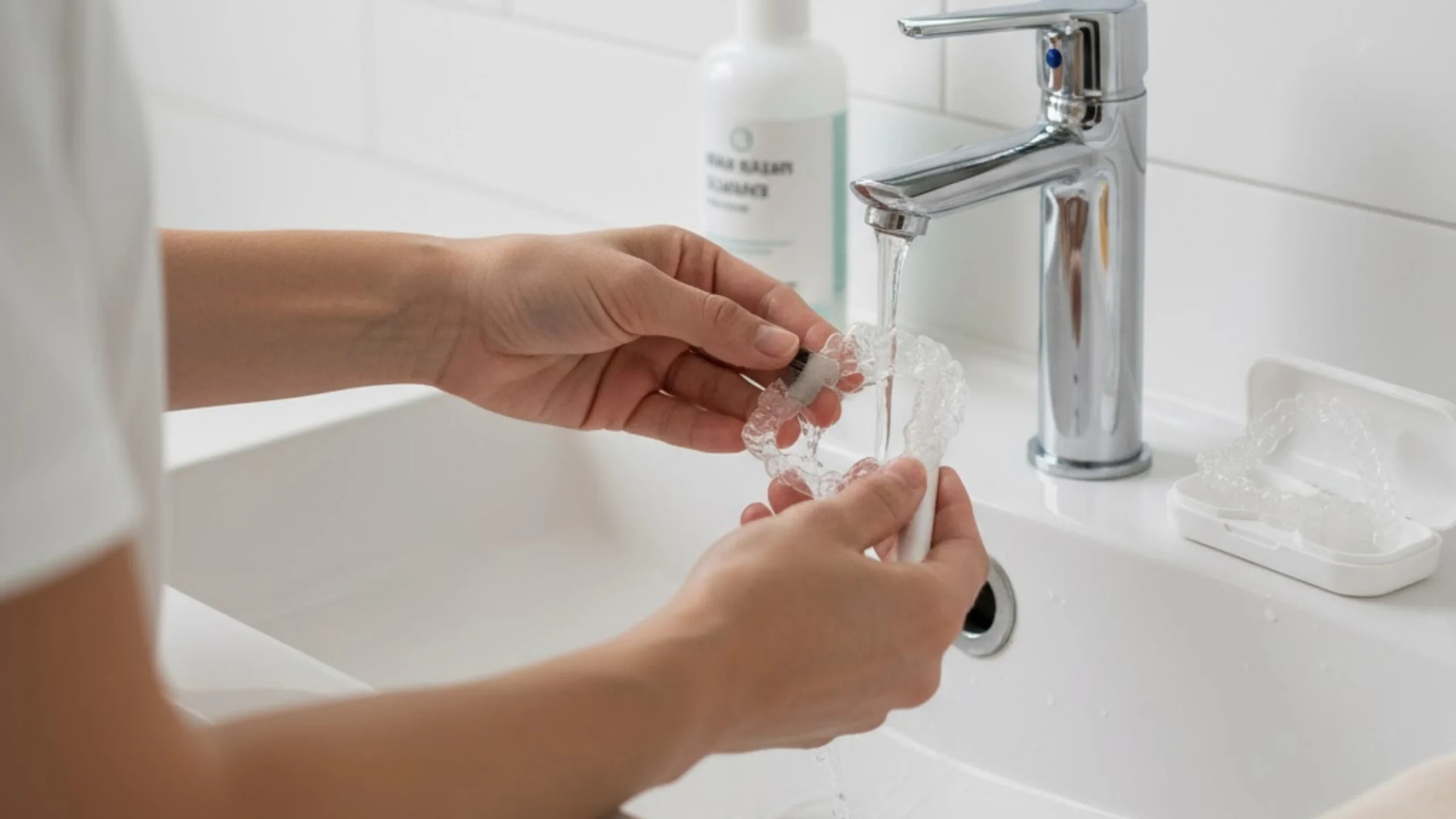
While cleaning the lingual surfaces requires attention, it is manageable with appropriate oral hygiene aids. In addition to a soft-bristled toothbrush, patients should utilize an interdental proxy brush, an end-tufted single-head brush, and an oral irrigator (water flosser) to clear sub-bracket margins. Notably, continuous salivary bathe from the sublingual and submandibular ducts provides natural protection against lingual caries formation.