Contentsexpand_more
- What is a Zygomatic Implant?
- In Which Clinical Scenarios is Zygomatic Implant Treatment Indicated?
- How is Zygomatic Implant Surgery Executed?
- What are the Primary Zygomatic Implant Advantages?
- Is Zygomatic Implant Dangerous? Understanding Potential Complications
- What Do Patient Profiles State in Zygomatic Implant Reviews?
- What is the Structural Zygomatic Implant Lifespan?
- How Much is Zygomatic Implant Pricing in 2026?
- Frequently Asked Questions (FAQ)
- Will I experience sharp physical pain during zygomatic implant surgery?
- Should I expect massive facial swelling following cheekbone implant placement?
- If I present with absolute zero upper jaw bone volume, is this treatment still a definitive solution?
- Can the presence of long zygomatic fixtures induce permanent chronic sinusitis?
Advanced dental medicine and contemporary maxillofacial surgery have reached a technical echelon where patients previously diagnosed as "impossible to treat with dental implants" due to catastrophic bone loss can successfully achieve full oral rehabilitation. Widespread, long-term edentulism, severe facial trauma, oncological resections, or advanced systemic osteoporosis can lead to extreme bone loss within the maxillary (upper) arch. In these advanced clinical presentations, the massive downward pneumatization of the maxillary sinuses coupled with horizontal bone melting leaves traditional implant options completely unviable. Historically, these individuals faced extensive, highly painful multi-stage bone grafting (sinus lifts and block augmentations) spanning over a year.
However, advanced modern oral surgery bypasses the compromised upper jaw bone entirely, securing rigid structural fixation within one of the densest, most highly stable bone complexes of the human craniofacial architecture: the cheekbone. This procedure is clinically classified as a zygomatic implant. This structural guide comprehensively evaluates the biomechanical framework, surgical protocols, and financial metrics of this specialized intervention for total edentulism.
What is a Zygomatic Implant?
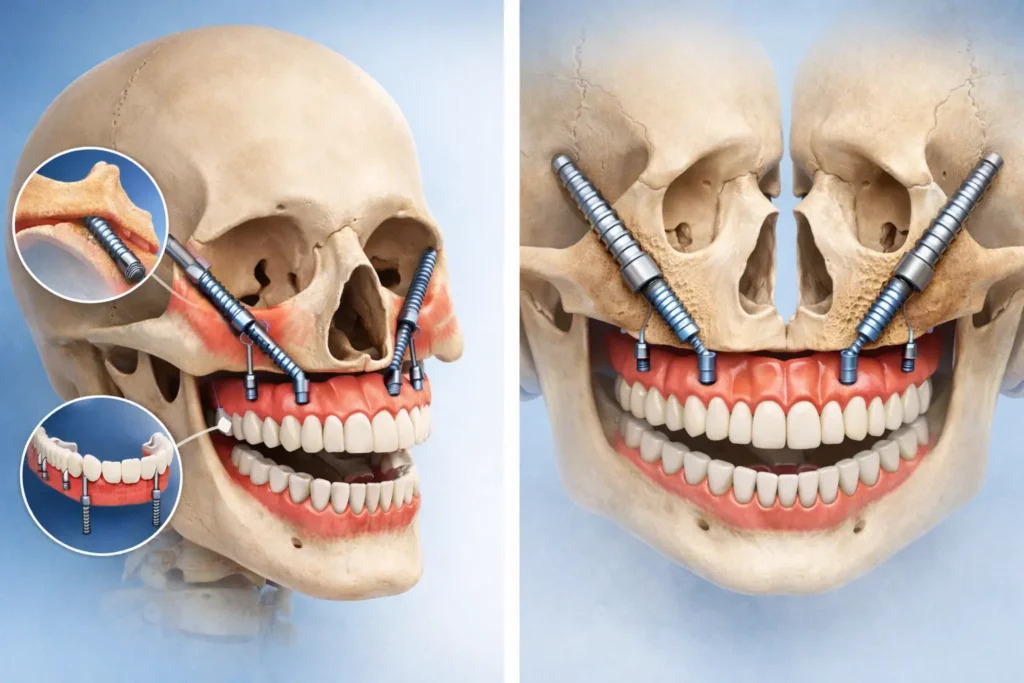
Traditional root-form implants strictly require a baseline threshold of alveolar bone height and width to achieve mechanical safety. So, what is zygomatic implant technology exactly? Unlike standard dental implants that measure between 8 mm to 12 mm in length, zygomatic fixtures are heavy-duty, specially engineered titanium posts ranging between 35 mm to 55 mm. These advanced fixtures pass completely through the residual, resorbed maxillary ridge to anchor directly into the deep, cortical matrix of the zygomatic bone (the cheekbone).
The cheekbone is anatomically immune to the localized osteoclastic resorption processes that destroy alveolar bone following tooth loss or periodontal disease. Consequently, even when a patient possesses zero millimeters of functional upper jaw bone, an exceptional biomechanical foundation is achieved.
In Which Clinical Scenarios is Zygomatic Implant Treatment Indicated?
Zygomatic implant treatment is not a primary option, but rather comes into play when there are specific indications. The situations in which this method is necessary are as follows:
Advanced maxillary resorption where the residual vertical bone height is measured below 3-4 mm across the entire posterior zone.
Catastrophic localized bone defects resulting from widespread, previously failed conventional implant reconstructions that failed to achieve osseointegration.
Complex craniofacial defects secondary to oncological tumor resections where a significant volume of the maxilla had to be surgically removed.
Severe flattening of the palatal and alveolar ridge caused by decades of ill-fitting, compressive removable full dentures.
How is Zygomatic Implant Surgery Executed?
Operating within this deep facial architecture demands specialized surgical training far beyond standard clinical dentistry. To secure absolute patient comfort and completely minimize acute procedural anxiety, zygomatic implant surgery is strictly executed within a fully equipped hospital theater under general anesthesia or deep intravenous sedation.
During the surgical window, our maxillofacial surgeon utilizes custom three-dimensional digital surgical templates derived from the patient's cone-beam computed tomography (CBCT). The long titanium fixtures are threaded through the remaining maxillary ridge and inserted at precise angulations directly into the thick body of the zygoma bone. Clinicians can utilize a combined matrix (two zygomatic implants in the posterior and standard implants in the anterior) or a four-fixture configuration known as Quad Zygoma for total maxillary replacement. The entire surgical sequence is completed within 1.5 to 2.5 hours.
What are the Primary Zygomatic Implant Advantages?
When contrasted against traditional reconstructive bone grafting models, the biomechanical and cosmetic zygomatic implant advantages are definitive:
A Completely Graftless Solution: Eliminates the medical requirement for autogenous block bone harvesting from the patient's iliac crest (hip) or chin, bypassing months of painful bone healing phases.
Fixed Teeth on the Exact Same Day (Immediate Loading): Because the cortical matrix of the cheekbone offers incredible initial mechanical torque, these fixtures instantly achieve high primary stability. This clinical parameter lets our prosthodontists load a custom-milled, fixed temporary bridge within hours of surgery, allowing the patient to leave our clinic with functional teeth.
Drastically Accelerated Treatment Lifespan: Traditional bone grafting lines require up to 12 months before permanent prosthetics can be safely loaded; zygomatic configurations deliver final zirconia or porcelain restorations within 3 months.
Is Zygomatic Implant Dangerous? Understanding Potential Complications
When executing extensive research online, prospective patients frequently focus on safety metrics: is zygomatic implant dangerous to undergo? From a clinical toxicological and surgical perspective, the answer is no provided the treatment is engineered by a certified maxillofacial surgeon who possesses deep mastery over midfacial anatomy, orbital boundaries, and facial nerve pathways. If handled by untrained clinicians, serious risks emerge.
Evaluating potential zygomatic implant complications reveals risk parameters such as transient acute sinusitis, minor epistaxis (nosebleeds), localized peri-implant soft tissue inflammation, or rare micro-fractures of the zygomatic body. Mapping the entire structural route via 3D computer-guided navigation systems drops these complication rates close to zero.
What Do Patient Profiles State in Zygomatic Implant Reviews?
When analyzing the clinical data and tracking comprehensive zygomatic implant reviews from patients treated at our clinic, the prominent feedback centers on psychological restoration. Patients express deep gratitude for transitioning from mobile, painful "false teeth" to highly stable, structurally fixed teeth that let them chew hard foods effortlessly. While experiencing localized edema (swelling) and minor ecchymosis (bruising) around the cheeks and lower orbital margins during the initial 3 to 5 post-operative days is a normal biological phase, patients report that these symptoms are comfortably controlled using our specific prescribed analgesics and cold compresses.
What is the Structural Zygomatic Implant Lifespan?
From a metallurgical perspective, these specialized fixtures are manufactured from pure biocompatible titanium alloys, achieving absolute structural integration with the host bone (osseointegration). Statistical clinical data regarding zygomatic implant lifespan demonstrates that when combined with rigorous home hygiene maintenance and routine check-ups every 6 months, these restorations maintain an exceptional lifetime (permanent) survival rate, remaining stable for decades without suffering bone loss.
How Much is Zygomatic Implant Pricing in 2026?
Because this modality demands specialized specialized component engineering, custom surgical navigation templates, and hospital general anesthesia parameters, the capital outlay is higher than standard dental implant therapies. The precise zygomatic implant price is dictated by whether the presentation requires a bilateral or unilateral setup, the specific implant manufacturing brand selected, and the final biomaterial used for the permanent hybrid bridge (such as monolithic zirconia or porcelain fused to titanium).
Per the current 2026 data, evaluating how much is zygomatic implant surgery reveals that the localized surgical fee for placing zygomatic fixtures is approximately 3 to 4 times greater than a standard root-form implant sequence. To receive an exact financial breakdown, an intraoral digital screening backed by a 3D CBCT scan is a prerequisite at our department.
Frequently Asked Questions (FAQ)
Will I experience sharp physical pain during zygomatic implant surgery?
No, absolutely not. The entire surgical procedure is conducted under general anesthesia or deep IV sedation, ensuring the patient is fully unconscious throughout the sequence, experiencing zero pain, noise, or discomfort.
Should I expect massive facial swelling following cheekbone implant placement?
Because the surgical field directly involves the midfacial zygomatic complex, experiencing localized edema (swelling) around the cheeks and under the eyes during the first 48 hours is a standard physiological healing response. These symptoms subside rapidly after the third day utilizing targeted anti-inflammatory drugs and scheduled ice applications.
If I present with absolute zero upper jaw bone volume, is this treatment still a definitive solution?
Yes. In extreme cases where the maxillary bone has fully dissolved due to chronic pathology or severe trauma, zygomatic fixtures bypass the jaw bone completely, making this treatment the premier, ultra-reliable alternative solution to restore stable teeth.
Can the presence of long zygomatic fixtures induce permanent chronic sinusitis?
Anatomically, zygomatic fixtures routinely pass through the lateral space of the maxillary sinus cavity. If the sinus tissues are confirmed healthy prior to surgery and the clinician utilizes correct guided angles, the procedure does not induce chronic sinusitis. Any minor, transient post-operative mucosal irritation is easily managed with brief medications.