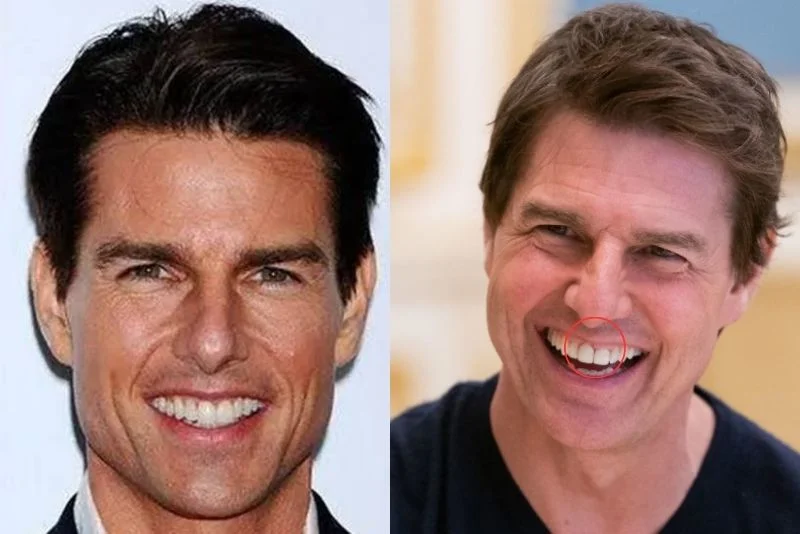
The cultural conversation around Tom Cruise Teeth has never really disappeared. Some celebrity smiles vanish from the collective conversation, because the visual signal is weak or the symbolism is too generic. But Tom Cruise Teeth stayed persistent. People still screenshot, dissect, pause frame and compare. Not because they want to gossip, but because the smile itself became a reference object inside dentistry oriented media culture. The smile not the person became a design variable. And this is the actual interesting part: how a visual reference becomes a data like anchor in everyday conversation.
We aren’t here to confirm procedures; we aren’t here to draw clinical conclusions. That is not Livera Clinic’s tone. Instead the purpose is to understand how this particular smile became a cinematic symbol of “face consistency,” and why Tom Cruise Teeth still behave like an evergreen example across TikTok dentistry commentary, Reddit smile design communities, and aesthetic culture timelines.
Why Tom Cruise Teeth Became a Visual Landmark
This is where the story really becomes fascinating: Tom Cruise Teeth aren’t just a celebrity artefact they became a measurement tool for fans who evaluate dental symmetry through pop culture heuristics. When a fan online says “it looks like Tom Cruise center line misalignment correction,” they aren’t trying to be dental experts. They are using Tom Cruise Teeth as metaphor language. A symbolic shorthand. A reference that compresses years of aesthetic interpretation into one label.
Visual culture people do this all the time. They compress complexity into a single symbol. “Audrey Hepburn Eyes.” “Zendaya Veneer Naturalism.” “Chris Hemsworth Jaw Geometry.” The reason Tom Cruise Teeth survived in this category is because the icon was caught right at the shift between analog cinema and HD based image consumption. Old film lenses… then suddenly 4K close ups. The smile became immortalised in that transition.
So ironically fans treat Tom Cruise Teeth like a time stamp for screen evolution.
Tom Cruise Teeth Midline Narrative & Orthodontic Awareness
Before the HD era, midline offsets were not “discussed” by average fans. You needed to be a dentist to even notice subtle biomechanical patterns. But when 4K screens entered the home, the public eye gained magnification powers. And that’s when Tom Cruise Teeth became a “catalyst concept.”
People use Tom Cruise Teeth to understand the idea that symmetry is not binary. That “perfect” is not mathematically perfect. That visual confidence is not limited by scientific alignment ratios. This is the exact point that makes the narrative academically interesting for a clinic blog. It proves how a celebrity smile can shift audience literacy.
The audience learned to “see” without becoming clinicians.
◦ not diagnosing
◦ not calculating
◦ but recognising patterns
That is cultural semiotics.
And this is why Tom Cruise Teeth are still relevantbecause they taught non experts the language of image based dental noticing.
How Tom Cruise Teeth Became a “Data Node” in Pop Culture Smile Mapping
When people online compare a modern celebrity smile to Tom Cruise Teeth, they’re not consciously trying to behave like dental analysts yet that’s effectively what they’re doing. They are performing “pop culture data mapping.” In plain language: viewers create internal visual folders. A tooth form becomes a symbolic signal. Just like the 90s haircut shorthand “The Rachel,” this smile became a reference anchor.
That is why Tom Cruise Teeth are not merely aesthetic; they carry semantic weight. TikTok dental commentary or Reddit aesthetic threads prove something subtle the audience doesn’t measure information, it thinks in references. And Tom Cruise Teeth represent an iconic symbol of screen era dentistry narrative.
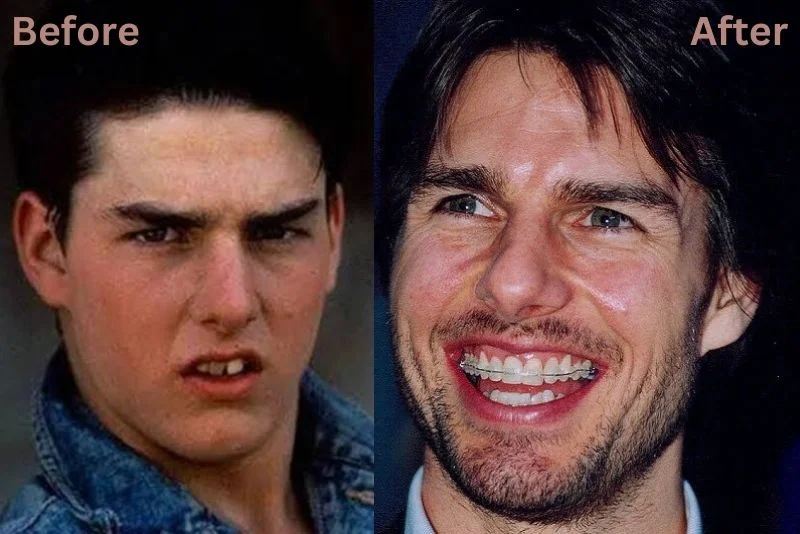
Why the Tom Cruise Teeth Timeline Proves Iterative Visual Adjustment
In modern aesthetic discourse, binary before/after thinking is evaporating. People no longer assume transformation happens as a single dramatic intervention. They talk in terms of iterative refinement. And Tom Cruise Teeth illustrate this perfectly.
There was no abrupt shock conversion.
Instead:
- season to season micro modification
- evolving photogenic calibration
- subtle harmonising with evolving camera optics
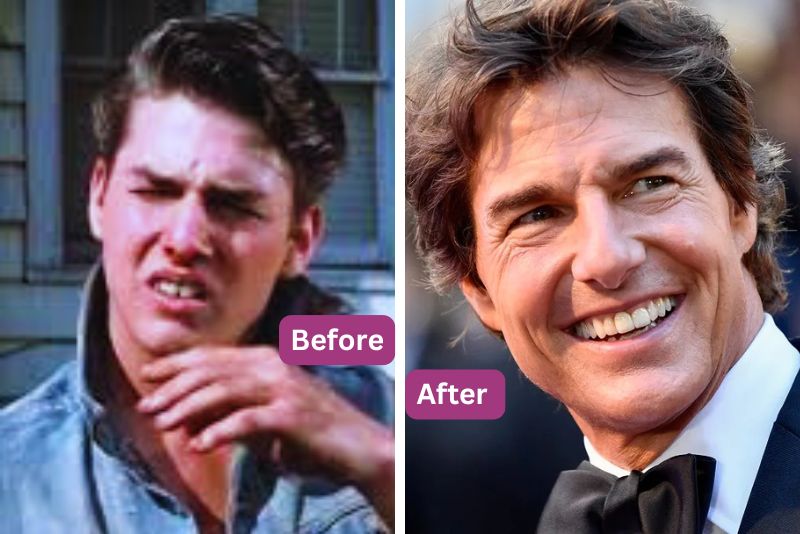
As screen technology increased resolution, viewer eyes increased semantic resolution. And this is precisely why Tom Cruise Teeth became a “narrative benchmark” inside aesthetic culture because the public realised that a smile story is not a one frame phenomenon; it is a timeline.
That’s a huge cultural shift: the idea that facial aesthetic interpretation is time layered instead of episodic.
Why Tom Cruise Teeth Are Referenced Even in Non Dental Communities
This may be the most ironic part of the entire phenomenon.
Most aesthetic vocabulary in pop culture starts inside specialist rooms, then travels outward to mass media. But Tom Cruise Teeth travelled the opposite direction. It originated outside dental circles from movie frame analysis channels, cinephile frame comparisons, HD breakdown essays then migrated into dental speak.
That is extremely unusual.
It is reverse diffusion of aesthetic language.
This proves that Tom Cruise Teeth is not merely a celebrity trivia unit it’s a case study of how cinema influenced the public vocabulary of dental semiotics.
And that is why today, using Tom Cruise Teeth as a shorthand is not superficial. It represents the moment where media culture rather than biomedicine taught the audience how to “notice.”
Why Tom Cruise Teeth Function as a Narrative Continuity Symbol
One of the most overlooked aspects of Tom Cruise Teeth is not the tooth morphology itself but how stable the visual identity remained across decades of changing cinematic context. In a world where celebrity faces mutate fast, this smile acted like an anchor. Audiences subconsciously track continuity. They want something that holds steady while everything else accelerates.
That is the deeper psychology behind why this particular smile became a fixed reference point.
People don’t admire the geometry they admire the persistence of geometry.
The smile became a stabiliser of perception.
So instead of asking “what exactly changed?”, many people end up asking “why didn’t this dissolve under the volatility of fame?”
That’s how Tom Cruise Teeth ended up as a continuity index: a reminder that visual familiarity is a currency.
Why Celebrity Smile Culture Is Public Learning
When aesthetic clinics produce content, the goal is not to manipulate desire or to claim definitive causality. Livera Clinic’s stance is closer to cultural anthropology: we study how audiences talk about beauty. We study the language of noticing.
And Tom Cruise Teeth are a perfect example to analyse because they illustrate how viewers became more literate in symmetry discourse without ever entering dental school.
The audience learned by:
- comparing screenshots
- absorbing social memes
- interpreting micro adjustments across time
That means the public’s literacy evolved through entertainment media, not textbooks.
So when we reference Tom Cruise Teeth as a cultural symbol, we are not instructing anyone we are documenting the behaviour of perception.
Why Tom Cruise Teeth Will Continue to Be Referenced for Years
Tom Cruise Teeth represent more than celebrity smile trivia. They are one of the clearest examples of how visual culture can reverse educate a field how pop can teach specialists, instead of specialists teaching pop. And that makes this case historically relevant for anyone studying aesthetic semiotics.
This smile shows that cultural memory prefers continuity markers.
It proves that iterative identity feels more believable than sudden metamorphosis.
And it reinforces the idea that viewers read faces not just as anatomy but as evolving narrative objects.
For Livera Clinic, this analysis confirms that aesthetics is not merely a “result”… but a literacy system.
A literacy system shaped by cinema and stored in the public eye through symbols like Tom Cruise Teeth.